[8.0/10] There’s a scene in Peter S. Beagle’s *The Last Unicorn*, where a long-suffering woman named Molly Grue encounters one of the titular fabled creatures, reputed only to come to unblemished young maidens. And rather than exalt at this minor miracle, Molly is aghast, affronted, even hurt, to witness the sight before her.
She scolds the creature: "Damn you, where have you been?” And when the unicorn responds that she’s here now, Molly laughs a bitter laugh in response. "And what good is it to me that you're here now?” she retorts. “Where were you twenty years ago, ten years ago? How dare you, how dare you come to me now, when I am this?” Hers is a reaction born of unfulfilled longing. There is anger, and tears, and ultimately forgiveness born of each.
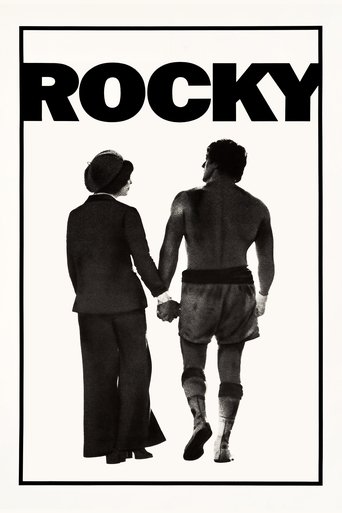
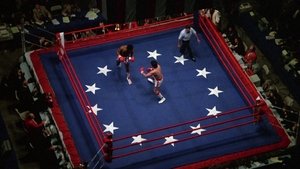
It’s an admittedly odd line to draw, between an imaginative and soulful fantasy tale and an earnest yet gritty boxing film. But at the turning point in Rocky, when this “bum from the neighborhood” is granted the thing he’d long dreamed of, but had resigned himself to being out of reach, Molly’s reaction to her own dream denied leapt inexorably to mind.
For Rocky Balboa, a shot at the heavyweight champion of the world *is* a unicorn -- a bit of “freak luck” for an opportunity that once seemed impossible. In a film whose place in cinematic history thrives on big moments, there may be nothing more piercing than Rocky quietly, humbly turning down the fight of his life because he deems himself unworthy of it. There may be no more human moment in the film than the way his gaze lingers at a picture of himself at eight years old, implied to be wondering how this smiling young child could have become this no-account thug.
And there may be no moment more heartbreaking than when he lobs eerily similar recriminations at his trainer, Mickey. “Took you long enough to get here,” he barks back at the man offering to be his manager. “I needed your help about ten years ago, right? You never helped me. You didn't care.” And the same anger at a blessing arrived too late that once burst from the lips of Molly Grue practically radiates off the silver screen. “Talkin' about your prime. At least you had a prime!” he fumes at his would-be mentor, who comes with his own share of long-simmering regrets. “I didn't have no prime. I didn't have nothin.” And once more, the moment ends with the same anger, the same tears, and ultimately, the same forgiveness.
That is the crux of *Rocky*. For all its squared circle glory and slice-of-life Philadelphia grit, at heart, this is a story of self-worth. It is a film founded on the idea of something fantastical falling out of the blue, at such a peculiar time in our hero’s life that he doesn’t know what to do with it.
Who wouldn't find it overwhelming, to face down your dream at a time when you feel like you're no longer capable of achieving it? Rock Balboa has his shot. But he doesn’t feel like he can do it. More than that, he doesn’t feel like he deserves it.
And the power of the film is that, in the end, through work and humility and love, he does deserve it. Rocky rises to the occasion and earns this thing he once refused to believe himself worthy of. His triumph in the ring, the hard-won proof of his own self-worth, wouldn't matter at all if we didn’t get to see not just his bitter lows, but Rocky Balboa’s sad reservoirs of self-doubt, at the moment when his own thing of myth arrived at his doorstep.
What bolsters that journey is the sense of authenticity that permeates the film. Sylvester Stallone is not the world’s greatest thespian. Many of *Rocky*’s scenes drag and bumble around. Many of the moments it puts on display are downright unpleasant, even distasteful. But what saves it all is the sense of realism that abides throughout it all.
Rocky may not be the most articulate or sensitive figure in the world, but by Stallone’s own script, he has the ring of truth of someone you might meet down by the docks in 1970s Philadelphia, which makes his rougher edges easier to swallow and his better qualities that much more admirable. *Rocky* is not a crisp film from the editing bay, with rambling conversations and logy scenes. But the presentation helps the audience soak in the blue collar texture of the film so important to where Rocky comes from and how that informs who he is, alongside letting us get to know the man himself better through each little vignette.
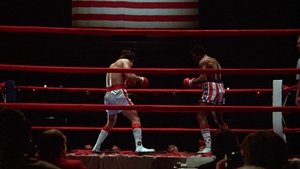
Much of that comes through in the filmmaking. It is rare in cinema today to see such frank poverty, domestic strife, and frankly, stupidity. There is a grim-and-gray unvarnishedness to Rocky’s ecosystem that director John G. Alivdsen and cinematographer James Crab put on display without softening the blow. We don’t have to be told that Rocky’s apartment stinks when he yells it at Mickey, because it looks it, because his circumstances and the humble world he comes from tells the tale in images as much as in words. And it’s a marked contrast from the glitzy, heart-pumping, living-color shots of the big fight. The distinction’s made manifest in quick cuts, heavy blows, and a big fight feel whose visuals note the distance between this shining vista and the hardscrabble pit that Rocky crawled out of.
The film uses that environment to establish who Rocky is, where his flaws lie, and what makes him worth holding up to the light anyway. There is something strangely refreshing about seeing a character who is more decent than he is clever, who is more retiring than he is bold, and to be candid, who is dumb. By his own admission, Rocky is not a bright man, and seeing him struggle through a world of people craftier than him, but win the day not by outsmarting them, but by his decency and work ethic, is a kind of inspiring you don’t always see.
Because Rocky Balboa is full of equal and opposite facets of his soul. He’s a man who makes his living on violence, but who hesitates to break thumbs as muscle for a loan shark. He has a temper and can be provoked in and outside of the ring, but he tends to shrink from confrontation and prefers the easy way over the hard way. As hard a man as his dual professions would seem to suggest, he’s a sensitive soul as apt to tend to small animals and find himself attached to wounded birds as he is to snap legs and throw haymakers.
In short, there is a truth to Rocky Balboa, and it’s what makes the film work. He is not a pristine protagonist. He’s made mistakes and he makes still more before our eyes. But he feels like a real person, in a real place, facing real struggles, in a way that makes it easier to excuse his and the movie’s foibles, given the sense of truth on display.
Which is why the movie’s most unnecessary moments come when they stop feeling like the elliptical conversations of a man on the street and start feeling like movie dialogue. We don’t really need Mickey announcing to Rocky that he had the talent to be a great fighter but squandered it. We don’t need Rocky monologuing to Adrian that he just wants to go the distance with Apollo Creed in order to regain his self-esteem. The moments where the movie tells instead of shows are conspicuous and detract from the verisimilitude that is one of its best features.
So does the fact that, as for any movie nearly half a century old, the values on display can feel jarring, even disturbing, to the modern eye.
There is something uncomfortable in the subtext of *Rocky*’s racial politics. However well-intentioned, it’s hard to elide the topics of Rocky Balboa as a poor, working class white man, striking a blow against the flashy, wealthy black man who is now claiming the mantle of American. Barely a decade after the passage of the Civil Rights Act, it’s hard not to read some racial resentment, not to mention some wish fulfillment in the form of Rocky as “the great white hope,” into the film’s story that plays as distasteful to the modern viewer. The fact that Creed himself is playing up that framing within the story of the film adds to the problem, while at least acknowledging it.
That said, it’s telling that the film takes care to show that when a local bartender accuses Apollo of being a “jig clown,” Rocky pushes back and praises Creed since he “took his shot and became champ,” and clearly admires the hell out of the champion of the world. The racial element is impossible to ignore, but at its core, the difference between them is presented less as black-and-white than it is between the man taking the match seriously as the fight of his life, and the man treating it as a spectacle and just another business opportunity. Hell, one of the best moments in the movie comes when Creed realizes what he’s up against, and starts treating this like a fight rather than a spectacle, showing how he didn’t reach this mountaintop by accident.
There are no such hedges to be found for Rocky’s courtship of Adrian. The film seems to be on Rocky’s side when he manhandles a young woman away from the stoop and warns her not to develop a reputation as a whore or continues to insinuate himself into Adrian’s life despite her clear shyness and discomfort. You can write this off as another concession to realism, how the sense of right and wrong and social graces would manifest for someone in Rocky’s position. But you can't excuse the end of Rocky’s date with Adrian.
Let me tell you, it’s disquieting as all hell when Rocky cajoles Adrian to come into his apartment when she tells him now, brushes off her request to call home, and responds to her explicit statements that she feels uncomfortable and doesn’t know Rocky well enough to be in his vulnerable state by blocking the door, cornering her, and forcing her to kiss him. There’s another version of this movie, where Rocky isn’t the lovable lug where a certain gracelessness is counterbalanced by a heart of gold, but instead, he is Travis Bickle in fellow 1976 feature *Taxi Driver*, the negative image of Rocky Balboa’s heartsick man of the streets.
It would be typical of the times, if not exactly admirable, if the film gave us this scene and moved on as though it were no big deal. But it’s worse than that. This spate of forced intimacy is not implied to be something that Adrian wanted but couldn't admit, but it basically “cures” her of her shyness. The implication is that Rocky trespassing on her boundaries prompted her to come out of her shell and that making her uncomfortable ultimately made her comfortable. That is a hell of a problematic message to send, whether fifty years ago or today.
The best you can say is that Adrian clearly comes from a place of abuse, where we witness her brother Paulie, possessed of his own regrets and bitterness, takes it out on her. There’s a heavy implication that much of her shyness, her reticence, her retiring nature, stems from the way that boorish Paulie dominates her life. To be charitable to *Rocky*, the best version of what it’s trying to do is tell the story of a man who shows he is not the brute her brother is, in a way that gives her the space and safety to be her full self. But my goodness, this is not the way to go about it.
That said, what makes the romance between Rocky and Adrian work in the end is that same thing -- self-worth. Paulie asks Rocky what he sees in his sister and he responds with some inarticulate but no less profound wisdom: “She's got gaps, I got gaps. Together, we fill gaps.” Contrary to Paulie’s immediate questions about sex, the point isn’t mere physical attraction, but that these two people fit one another, joined by the sense that the world told them they weren’t good enough.
One of the stronger moments in the film comes when Paulie is on a tear, rampaging against Adrian and calling her a loser. She finally has the gumption to bite back, to stand up for himself and vouch for her own self-worth. Beyond the sweetness we see between her and Rocky on a scene-to-scene basis once we move past that horrid encounter, we also see two people who feel like unwanted failures finding solace in the fact that even if the world doesn’t want them, they want each other. It’s a mutual recognition of a fellow soul having worth that inspires each of them to do better.
So yes, it is inspiring to see Rocky suck wind up the stairs of the Philadelphia Art Museum the first time only to dance atop them in triumph when he puts in the work. It is wholesome to see this down-on-his-luck little mascot of the slums raised up by a community rife with loss and regret as their mascot and rallying point. It is uplifting to watch this supposed bum knock down the champion of the world in the first round, to raucous cheers from his friends at ringside and his friends back at home.
But what elevates *Rocky* into something special isn’t that he ultimately loses the fight, or that he goes the distance, or that he earns the respect of the boxing world in that ring amid the chance he never thought he’d get. It’s that he doesn’t care about all the outside adulation. This was never about winning. It was never even about showing something to the world or the people back in the neighborhood. It was, instead, about Rocky proving something to himself, that he is worthy of this gift, worthy of the talents he’s finally made good on, worthy of the love he so desired.
Toss aside the bodyblows and flashbulbs. Toss aside the champion of the people and the split decision. What’s left is what matters: the tale of a man who thought his time was past, watched a unicorn of an opportunity fall in his lap, and buckled under the weight and self-doubt it stirred up in him. The most inspiring part of the film is not the bum who went bell-to-bell with the best. It is, rather, the lost soul, convinced of his own worthlessness and failure, who overcame that to rise to this occasion and show, if only to himself, that by god he was worth something.

 Plex
Plex  Kodi
Kodi  Stremio
  Jellyfin
  Netflix
  Disney+
  Prime Video
  HBO Max
  Trakt
Trakt  TMDB
TMDB  Letterboxd
  IMDb
IMDb  Simkl
Simkl  TVTime
 United States