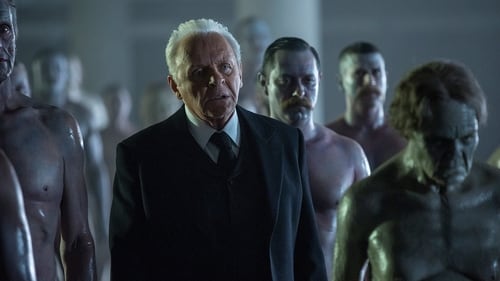
[7.9/10] One of the big mysteries that remained in *Westworld* was who Arnold is. Given the twists and turns of the show, it was entirely possible that Arnold didn’t really exist and Ford had made him up entirely, or that Arnold was Ford’s benevolent but Tyler Durden-esque alter ego, or that Arnold was actually some kind of crazy free-floating A.I. that was Ford’s first robotic creation and digital assistant.
Instead, it’s Bernard, or rather, Bernard is him, or to be even more precise, Bernard is a robotic recreation of Arnold who did not, until now, know what or who he was.
I don’t know how I feel about that reveal. On the one hand, it feels a little pat, as Maeve might put it. There’s something a little too “shocking twist” about the idea that “the guy everyone’s been looking for and talking about was under their nose the whole time!” There’s something that strains some credulity about the fact that Ford built a robotic replica of his former business partner and no one batted an eye, regardless of how much time may have passed.
I like a bit of clockwork in my mysteries, the sense that everything is connected and tied to a particular point, but there’s something that feels a little too easy, a little too dramatic, in this choice.
And yet, I like the poetry of it, and I like the presentation of it. *Westworld* can certainly become lost in a web of its own nebulous symbolism in a way that makes me roll my eyes. But there’s genuine ambition here. The frame story, such as it is, of Bernard unlocking his memories so that he can fully self-actualize, confront his real past, and know the whole truth, as Maeve suggests, gives “The Well-Tempered Clavier” a unique storytelling opportunity.
It lets the episode jump back and forth in time, not just to help illuminate who Bernard really is, but to blend his story with those of Dolores and Maeve, showing those points where the paths intersect that put everyone’s journeys into relief. The way the episode is edited, slipping the glimpses of past, present, and future next to one another, both allows the audience to share in the hosts’ disorientation, but also let’s the show find meaning in the juxtapositions.
We see that in particular in the haunting imagery of Dolores’s journey into what we can only assume is the heart of the maze. The scene of her approaching the church is framed to where the tower looms over her, seemingly representing the power of an institution, of those who might declare themselves gods, making her seem small by comparison. She wanders through pews of others like her muttering in madness. And she descends into some version of the original laboratory, drifting between it as it was then and as it is now, with the implication that she’s done this before, that her efforts to break out just send her into a different, but still familiar loop.
This is *Westworld* using the tools in its cinematic toolbox to create the meaning in these events, to evoke the mood using something beyond just grand speeches or threats exchanged between characters.
But the other big reveal of the episode comes in one of those conversations, when some combination of Arnold in the past and Dolores’s memory reveals that Arnold died at Dolores’s hand. That lends itself to the poetry of the episode, where a man who seemed to believe in pushing his creations beyonds their limitations may have been felled by one who exceeded them.
I’m not convinced, however, that Arnold’s death was a murder. This episode also gives us flashbacks of Teddy’s murders at the behest of Wyatt, the central figure in the new story crafted by Ford. We know that Ford likes to put some truth into his heart of his stories, and it’s not a far leap to surmise that Wyatt is his stand-in for Arnold.
So when we see Wyatt gunning down everyone and everything in sight in what appears to be the original site of Westworld, he may very well represent Arnold, either literally or figuratively attempting to destroy what he created. The little we see in flashbacks and through Ford suggest friction between the two partners, particularly as regards whether and what to do with the hosts who’ve gained sentience.
Some may have joined Wyatt’s gang, the group of seemingly self-aware hosts who confront The Man in Black. Some of it may be connected to William, whose response to Logan’s trespasses here -- a brutal massacre of his robotic running buddies -- looks like something out of Wyatt’s playbook.
But maybe Arnold saw where Ford’s thinking was going. Maybe he grew horrified at the idea of sentient beings under someone else’s control, trotted out for amusement or torture, and couldn’t live with the idea of the park continuing as it has. Maybe he tried to erase all of the progress they’d made and, when it was finished, tried to have himself “erased” as well, because he thought Ford couldn’t recreate it all without him, not the “most elegant” parts of it at least.
And maybe that’s why, beyond pure sentiment, Ford tried to recreate his partner, so that he and Bernard could achieve through Ford’s forced acquiescence what he and Arnold could not due to Arnold’s resistance.
This is all rank speculation on my part, but whether these extrapolations are true or not, the episode delivers on the existential panic at the end of its hosts quests that comes from the truth about Arnold’s history. For Dolores, it means that she’s been chasing a ghost, that the voices in her head telling her to follow, to find something more, blended with haunting memories of the past, have led her to a dead end. The quest she is on, to fulfill that aching need inside of her, cannot be fulfilled, at least not like this, because she’s tried it before and come up empty.
Bernard’s quest is less tactile, more cerebral, but it ends similarly. By probing his own memories, memories which the hosts cannot only recall but interact with, he hopes to find answers, to remember the person who might be able to give him some. Instead, he only finds reminders of past grisly deeds forced to be performed, and ultimately, himself, after a fashion. There are few things more frightening than chasing after the person you think can give you the guidance and direction you need, only to find that the only person there is yourself.
That realization adds menace to Ford’s salutations, as the characters cracks into more raw villainy. The curtain has fallen. Another reveal has been revealed. And neither Bernard nor Dolores, nor even Ford, can remain the same in our eyes after what happens.
*Westworld*, in its first season at least, is a show founded on establishing those mysteries and then answering them with maximum shock. And when “The Well-Tempered Clavier” is straining to shock me, to surprise me, it feels like hollow and pulp. But when it’s mining those reveals for something deeper, for the existential dread of its characters, for the philosophical conflict between the animating angel and devil of this world, for the more personal experiences of its heroes and villains, it feels like something realizing the potential, however fleetingly, of the show’s fertile, fascinating premise.

 Plex
Plex  Kodi
Kodi  Stremio
  Jellyfin
  Netflix
  Disney+
  Prime Video
  HBO Max
  Trakt
Trakt  TMDB
TMDB  Letterboxd
  IMDb
IMDb  Simkl
Simkl  TVTime