[9.2/10] It’s too simple to reduce people to “good” or “bad,” and so it should be just as hard to reduce characters to the same binary. Most stories have heroes and villains, champions and foils, but in the right hands, you should be able to squint and see almost any person in a story in a different light.
But I cannot help walking away from “The Bicameral Mind”, the finale of *Westworld*’s first season, without wondering whether Ford is the good guy or the bad guy. And that’s a feature, not a bug.
Because on the one hand, he has done some terrible things, first and foremost killing Theresa and Elsie. If that weren’t enough, his new “narrative” seems poised to lead to the deaths of many more, if past is prologue and Dolores’s killing spree as Wyatt is as prolific as her former one. More than that, he’s done arguably morbid or ethically perverse things, like create Bernard in the image of a dead man, imbue him with another person’s tragedy, and keep his true nature under wraps until it could be emotionally devastating. What’s more, he fought to keep *Westworld* open when Arnold demanded their creations be set free.
But now he’s seemingly trying to make amends. He’s tried to pursue Arnold’s dream, of identifying and nurturing the growth of the hosts with the potential for sentience. He’s recognized not only his creations’ humanity, but their superiority. Despite his lethal efforts, he wants to set them free, to turn the park over to them, to give them the tools and the power to dictate their own destinies away from human control that might cabin them or use them for more nefarious purposes.
It’s hard to know how to zero out that moral calculus. Ford’s methods are severe, reprehensible even, but framed as, at least potentially, the only way. He is a man with moral bills to pay, trying to clear himself, to recognize what he denied for so long. As much as Ford has been a walking stream of cryptic hints, his true self is revealed in this finale, as a man with questionable ethics arguably pursuing a noble corrective to his past mistakes, occupying the sort of moral gray area that are the stock and trade of HBO’s dramas.
But that is, perhaps, the mildest reveal in “The Bicameral Mind.” Beyond Ford’s character and goals, we’re all let in on the secrets of who The Man in Black really is, the real story of Arnold’s demise and, relatedly, the flashes of memory Dolores, Teddy, and others have about a massacre in the early incarnation of Westworld.
I have to admit, those moments didn’t land with much, if any, shock for me, since it felt like the answers to all of those questions were fairly, if obliquely, telegraphed in prior episodes. That’s not a complaint necessarily. I love a good surprise as much, if not more, than the next guy (and Bernard’s true nature was a big one) but it’s more important that a show deliver reveals that fit with its themes and what’s come before, and the finale accomplishes this in arresting fashion.
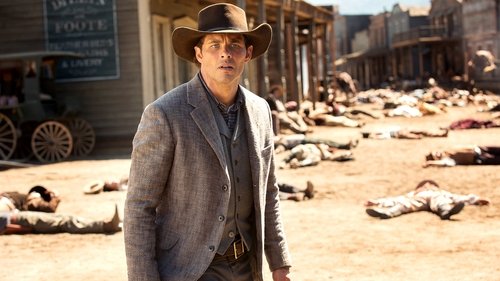
From the moment William picked out that white hat, the promise of a *Breaking Bad*-esque arc for him seemed too tantalizing for any T.V. writer to avoid to me. That meant that The Man in Black’s admission that he *is* William lacked some of the punch it might otherwise have as a shocking reveal. But while the surprise was minimal, the reveal still has power because it has power over Dolores, and because it jibes with the ideas the show is playing with in the episode.
“The Bicameral Mind” rushes over some of this, relying on the power of the montage and the superb talents of Jimmi Simpson as a performer to convey William’s change of heart without showing much of it. But it works as an exemplar of one of the chief themes of *Westworld* thus far -- that the park doesn't change who you are, it clarifies it, and shows you truths about yourself and the world that may be uncomfortable, or in William’s case, may redirect your life, but which are no less true.
And it works as a part of the most important journey in the episode, and the season as a whole -- Dolores’s. She finds that the man who she swears will come back for her, who will protect her, who loves her, is the one who is tormenting her. She yearns for something that isn’t there. She drifts back and forth through memories and reveries, finding that the center of the maze is not a particular destination as much as it is a personal one, the chance for self-actualization turned into a game.
“The Bicameral Mind” works its way in metaphors, with Arnold and Ford explaining the maze as a symbol, of the way that consciousness is not a straight line from memory to improvisation to something greater, but rather a winding path through each of these things, that borders on madness, but which leads those capable of finding it to a trinket that represents the achievement of something more, of a realization that spurs us to a higher state of being, or a soul, or to raw scientific sentience.
That thing, at least on Ford’s account, is suffering, an idea he borrows from his deceased partner. The maze that becomes the uber-symbol for Westworld is a toy from Arnold’s son, one that stands in for his own suffering. As Ford puts it, to be human, or to be conscious, is to want the world to be other than it is, to want without reason, to pursue because something calls you to it from within yourself, whether you want to or not.
It’s a powerful idea, one shared in a way with the Kubrick/Spielberg collaboration *A.I.*, which similarly posited that to love, even to love irrationally, could make an artificial being into no less of a person than a flesh and blood one.
And that sort of love called Arnold to try to save his artificial children before they would be made to suffer as his real life son did. The reveal that Dolores was “Wyatt” in the earliest incarnations of the park, that she acted at Arnold’s behest in an effort to avoid what he viewed as a great moral wrong, and that Arnold, in effect, ended his own life from some combination of his own such suffering and a desire to ensure that no such wrong could be enacted by his hand again, is not necessarily new information. The prior episode hinted strongly as this version of events.
But it’s still gripping to watch it in action, to see Arnold end his life, to see Teddy’s confusion at why this is all happening, to see Dolores’s horror and trauma to have these events flood back to her memory and summon her to more. So much of *Westworld* has been hints and promises that when the show pulls back the curtains and just gives answers, just shows you what it’s been trying to obscure and tease for nine episodes, there is an immediacy to it that gives these images and events a force even when they’re not truly surprises.
The same is true when Maeve (whether in the present or the past) enacts her plan to escape. She enlists the help of two of Westworld’s most capable bandits and in a set of crackerjack scenes, eliminates those who’d stand in her way and makes her escape. But she, like Dolores, wants the world to be other than it is, feels the pull of something less than real because it’s real to her. Westworld is just stories, as The Man in Black explains, but those stories bring their own sort of realness, and even with the chance to escape this caged hell, Maeve cannot leave her daughter behind, regardless of whether she knows that it’s all a fiction.
That gives her the same sort of moral complications. She and her confederates kill brutally in their efforts to escape. The show mitigates the horror a little bit by making their most prominent victims less than sympathetic, as Sylvester tries one last lie, as the lecherous tech means arrange an off-hours encounter with one the hosts that scans as violative, and both come out worse for wear. But in the process, innocent people, people whose only crime is doing their jobs, are killed at the hands of Maeve and her group.
And yet she too is reaching for something understandable -- the chance to seek her own destiny, to be free, to have her sentience be a gateway to agency and choice, even if the implication is that this too is part of the program.
It follows from the tone of Westworld, a show where characters do bad things for good, or at least understandable reasons, which muddies the waters when, say, Ford and Dolores start a robo-revolt with the hosts relegated to storage. When those robots advance on the assembled, The Man in Black smiles, because even if it ends his life, the game is finally real, the humans can finally lose, and in the midst of his quixotic quest, he inadvertently finds what he’s been looking for the whole time, or rather, it finds him.
In that moment, it’s hard to know who to root for. Those sitting around the fancy tables as Ford gives his speech include those who would change this place, simplify it, turn it into something manageable in the name of some greater, implicitly concerning goal. But there’s also otherwise innocent folks as well, whose only failing is not to understand, but who may or may not stand in the way of the hosts taking the park from them.
The actions of the hosts are orchestrated by Ford, who seems to sacrifice himself, in the hopes that he can get out of the way, that his end and his actions can be a bridge to his and Arnold’s creations inheriting the place that would otherwise be their prison, but who seems to now disregard the value of human life as little more than an unfortunate stepping stone between humanity and whatever is to succeed it.
So I don’t know if Ford is good for wanting to set his children free or bad how he means to do so. I don’t know if Dolores is good for human desire to move past the loops she’s been stuck in or bad if it leads her to kill in order to get it. White hats turn to black; killers show empathy for the things they love, and menacing old men try to set right what once went wrong. That is as human and real as any suffering, the messy, complicated lines that connect our better selves and our worse deeds.
The first season of *Westworld* was far from perfect, and the same is true of its finale. There is an ungainly quotient of drawn-out mysteries, and some of the first semester philosophy and overly-florid doublespeak that can’t quite make the leap to profundity. But “The Bicameral Mind” circles around those complexities, unleashes the series’ biggest secrets in raw but artistic fashion, and realizes the potential of this show and this setting where the lines between good and bad, between artificial life and the human soul, between the birth of a new age and the end of another, are blurred beyond discernment, and we’re only left to wonder what will emerge next.

 Plex
Plex  Kodi
Kodi  Stremio
  Jellyfin
  Netflix
  Disney+
  Prime Video
  HBO Max
  Trakt
Trakt  TMDB
TMDB  Letterboxd
  IMDb
IMDb  Simkl
Simkl  TVTime