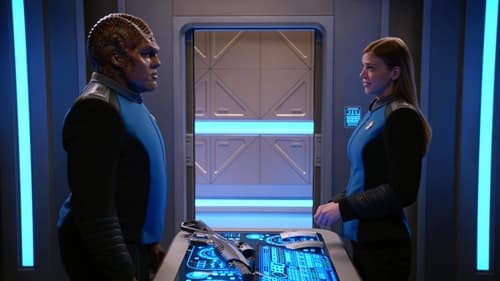
[8.3/10] When all is said and done, I feel confident that the Topa arc will be the greatest thing *The Orville* ever did. From her first appearance in “About a Girl” to the trajectory they’ve explored with the Moclans’ reaction to gender and sexuality since, there’s a great impact and meaning here than almost anything else the show does.
In this climactic next chapter in that story, the show comes down in a hard-won but aspirational place: doing the right thing right now matters more than what might happen in the future. It matters for the Union, who must decide to stand for the human rights of female Moclans even if it results in a “messy divorce” with the Moclans in the shadow of the Kaylon threat. It matters for Heveena, who must decide to admit her noble but law-breaking actions to continue smuggling female Moclans to her colony, that might imperil it, in order to put the full weight of the Union Council behind rescuing Topa. And it matters for Dolly Parton, who can walk and sing and give holographic advice just fine no matter what century it is.
There may be no bigger casting coup for the series than that. (We’ll see if Seth MacFarlane ever lures creative collaborator Patrick Stewart over to this spiritual cousin of the show he made famous.) *The Orville* made great use of Dolly Parton’s music and feminist bona fides in the last Heveena episode, and bringing her live and in person to inspire the Moclan liberator to do the hard thing and risk the lives of the many to save the one. Dolly’s a treat, as always. And while I have my qualms about the pollyanna lesson that doing the right thing now means everything else will work itself out, it fits with the aspirational tone of Star Trek and this story in particular.
And it is stirring and inspiring. There is such potent joy when Topa visits Heveena’s colony and sees women like her thriving. There is such relatable awe when she meets Heveena herself, an idol who spoke for Topa when Topa had no voice. There is something so heartwarming about Heevena turning that around and telling Topa that the revolution is *theirs* not Heevena’s.
Bortus stands up for his daughter in front of representatives for the entire Union, and it rends the heart. Grayson is invited to their family table when the smoke clears, affirming the important role she’s played in supporting all of them. And most questionably, but movingly, Kylden returns to apologize for all that he’s done and affirm his daughter’s right to be whoever she wants to be. This is an episode full of proud moral stands and a heavy dose of wish fulfillment, but by god, it worked on me.
It’s also an exciting episode. Despite the overlong runtime, the show does a good job of balancing action, character, and politics. While a little gratiutious, there’s plain stakes to Bortus and Grayson going on a blind mission to rescue Topa from the Moclans who are torturing her. The race against time, combined with a poor innocent like Topa suffering, help create an urgency to what the two of them are doing, even before the political implications. Bortus’ justified rage at his daughter's torturer, and the solid canyon chase following it help keep the blood-pumping throughout.
I am curious about the show teasing Grayson and Bortus as a couple. It feels like an echo of the Worf/Troi romance *Star Trek: The Next Generation* tried to pull off late in its run, with a helpful substitute parental figure also becoming a romantic figure. But she and Bortus have never really had that kind of relationships, and her interactions with Topa are pretty new, so it feels even more out of nowhere than the *TNG* pairing did. All that said, I’m not against it, especially if it spares us from more Grayson/Mercer romantic nonsense.
The political angle of this one works too. You’ll never go wrong balancing the moral against the practical in a Star Trek adjacent show, or deciding between the ethical responsibilities to an individual weighed against the ethical duties to many more people. As with the stories about the Krill, this episode does a good job of analyzing how much intolerance, bigotry, and bad faith a government will tolerate in the name of expediency. Watching Mercer and especially Gordon take a stand in favor of human rights (so to speak) is rousing.
All that said, I hope *The Orville* pays off the fact that its main characters are alienating ally after ally with a Kaylon threat looming. I have some faith that it will, but making these bold choices and grand stands doesn’t mean much if there aren't some kind of consequences down the line. That doesn’t have to mean destruction or anything, but there needs to be a cost to doing the right thing, or at least a good reason why the expected bad consequences don’t come to pass.
(Just a random guess, maybe *The Orville* finds a brilliant way to stop the Kaylon -- something with Timmis and Isaac convincing their countrymen why their view of biologicals is wrong, such that even the Krill and the Moclans can’t help but recognize the Union’s beneficence or something.)
I’m also a little leery of the wish fulfillment involving Klyden. He did and said some horrible things. He apologizes for them, and Chad Coleman is such a great actor that you 100% buy it. And it’s not crazy for a parent to have a change of heart when they think their child is in mortal danger. But his acceptance comes a little too easy, as does his welcome to Commander Grayson. I know there’s only so many episodes, but I wish we got at least some intermediate step beyond “I wish you’d never been born” and “I’m a loving and accepting father now.”
Still, the struggle and victories of the Moclan women is my favorite thing about *The Orville*, and this is another superior entry in their saga. Seeing Topa, Heveena, Bortus, and others rise up in the name of what’s right and just, not just what’s convenient and expedient, is stirring and inspirational, even if it involves some of the gloss and ease that only fiction can provide.

 Plex
Plex  Kodi
Kodi  Stremio
  Jellyfin
  Netflix
  Disney+
  Prime Video
  HBO Max
  Trakt
Trakt  TMDB
TMDB  Letterboxd
  IMDb
IMDb  Simkl
Simkl  TVTime