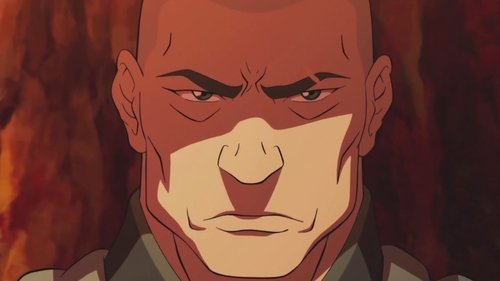
[8.2/10] It’s funny, when I was in the middle of this episode, I started to get a little worn out and thought to myself, “it’s about time we stop just building up these villains and start explaining who they are and what they want.” Much of the first half of this episode feels like wheel-spinning, with the pursuit of Aemwei being a fine enough plot-motivation, but leaving me starting to wonder when Korra and Co. were going to get to the proverbial fireworks factory.
Heck, I even started to get tired of Bolin’s antics, and he’s one of my favorite characters in the show! There’s some not so subtle symbolism in Bolin and Asami playing pai jhao, with the former trying a fast-paced instinctive style and the latter wanting to be more strategic and methodical, at the same time Korra wants to rush in and confront her enemies while Mako is advising caution and observation. Still, it felt like *TLoK* just drawing things out.
But then, you know, Korra aparated to the Spirit World, and Aimwei got dumped in the fog of lost souls, and the rest of Team Avatar is fighting a losing battle against half of Evil Team Avatar, and Zaheer is explaining his motivations and holy hell, business just picked up!
It’s all very exciting, but the most interesting part to me is learning what’s driving the newly revealed Red Lotus society. One of the big problems with Season 2 of *TLoK* is how opaque Unalaq’s motivations were, and how they mostly amounted to the usual “evil ‘cause I’m evil” megalomania. But Season 3 seems to be correcting for that. Sure, there’s something a little to plainly black hat about Zaheer booting Aimwei like that, or announcing that chaos is the natural order of things, but like most compelling villains, he has a point, even if it’s twisted to suit his ends.
Zaheer points out that Korra agrees with the Red Lotus Society’s initial goal of opening up the spirit world to try to create balance between humans and spirits. And he has an interesting position about the incompetence of leaders in the Four Kingdoms/New Republic. Sure, the *AtLA*-era water tribe chief was a good guy, presumably Zuko made for a good Fire Lord, and though in over his head, Tenzin seems like a noble leader for the Air Nation. But through the Avatar-verse we’ve seen problematic rulers. Wan’s time had fatcat nobles. Kyoshi had to take out a rebellious warlord type. Roku’s issues with Sozin are well documented. Aang’s time featured the malevolent Fire Lord Ozai and an incompetent Earth King hoodwinked by his manipulative advisor. And in the present we’ve had a New Republic President who refused to help and kicked Korra out, a selfish jerk of an Earth Queen, and a Water Tribe Chief who tried to become the Anti-Avatar. There’s a lot to dislike there (though it’s undercut a bit by how Zaheer was allied with Unalaq, even if he disclaims it now).
And there’s some nice real world connections, with Zaheer’s hopes corresponding to a “world without borders” ideas that has been bubbling in political science for decades. The fact that he doesn’t seem to want to antagonize Korra, that he has a distinct worldview, and his demeanor and philosophical bent set him apart from prior Avatar-verse baddies. It may have taken a while to get there, but once the episode hits the spirit realm, “The Stakeout” gets very intriguing and exciting.

 Plex
Plex  Kodi
Kodi  Stremio
  Jellyfin
  Netflix
  Disney+
  Prime Video
  HBO Max
  Trakt
Trakt  TMDB
TMDB  Letterboxd
  IMDb
IMDb  Simkl
Simkl  TVTime