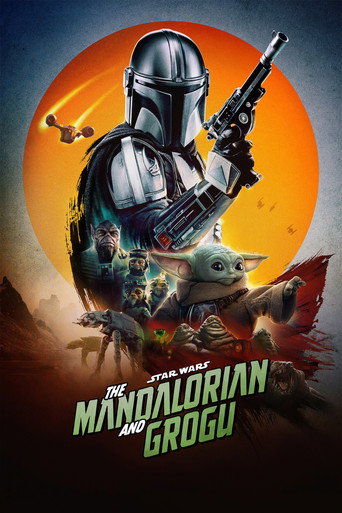
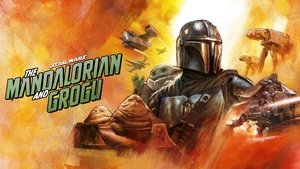
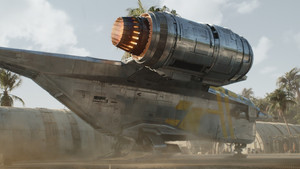
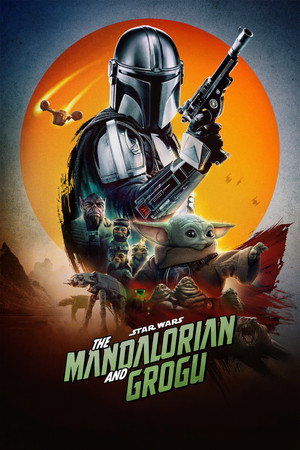
[84/100] The big question anytime a television show makes the leap to the big screen is also a simple one -- why does this need to be a movie? That goes double for *The Mandalorian and Grogu*. Despite (or because of) the use of “The Volume” to film the series, it already feels fairly cinematic in its construction. The title characters leap to new exotic locales from week to week. They regularly get into epic fights of both the space-bound and hand-to-hand variety. And season finales in particular come with major set pieces that pull out all the stops. In contrast to something like Star Trek, a franchise which ups its scope and action quotient when in theaters, *The Mandalorian* is largely already there on an episode-to-episode basis.
The 2026 film doesn’t break much new ground on that front. Sure, there’s a grandiose final confrontation that comes with plenty of fireworks. And sure, we get some new ships and new planets to horse around on. But in terms of story and spectacle, the silver screen sojourn is business as usual for *The Mandalorian*.
With those boxes checked off, the answer to the “Why a movie?” question becomes obvious -- a bigger screen and a bigger budget means a lot more CGI characters. From a pragmatic standpoint, *The Mandalorian* is arguably Lucasfilm’s biggest modern brand within Star Wars, and the franchise’s most iconic addition from the Disney era, so it makes business sense for the studio to try to capitalize on that notoriety at the box office But in terms of what the movie is doing that the T.V. show wasn’t already accomplishing, the only real answer is putting many more computer-generated figures on the screen alongside Din Djarin and the onetime Baby Yoda.
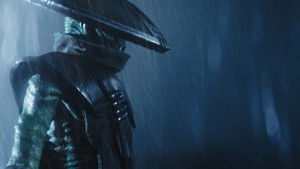
And hey, they’re pretty neat! Seeing a trio of hutts wrestle with one another is novel. Embo the bounty hunter and his canine companion give Mando and Grogu a run for their money. Garish creatures in gladiatorial games and crime lord death pits snap and claw at our heroes. A whole host of droids in all different shapes and sizes swarm the good guys and ignite an attack. A reptilian swamp-dweller turns out to be a good samaritan when it matters most. The cinema world’s #1 fan of big budget spectacle, Martin Scorsese, has a digital turn as a primate-like alien manning a food stand. Even Zeb Orrelios, the hulking purple alien of *Star Wars Rebels* fame, gets to be a significant player in a live action project for the first time.
Each of these things might be possible on streaming, but chances are, they couldn't all happen together. One of the few gripes against *Andor* is that despite the diverse array of denizens of the Star Wars Galaxy, aliens were scarce. So with added budget to bring more of that flora and fauna to life, *The Mandalorian and Grogu* goes absolutely wild with putting CGI characters in major roles that would be trickier when spreading out those funds across eight episodes.
The problem is, that's all the movie really has to distinguish itself. This is, ultimately, a pretty standard adventure for the title characters, the kind they embark on with regularity. The piloting from Zeb and return of Rotta the Hutt and bounty hunter battles with Embo are all cool enough. But there’s no real upgrade in scope or scale, or a particularly meaningful story being told here, that makes *The Mandalorian* feel special enough for its leap to the silver screen.
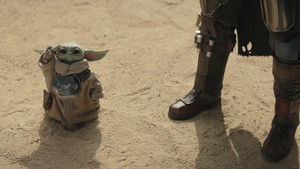
Oddly enough, all that computer-generated wizardry is not the most engaging visual element of the movie. It is, oddly enough, the use of old school puppetry and stop motion animation that catches your attention more. Despite a comparatively lesser range of expression, Grogu is still the star of the show, with his gentle little waddle, teeny coos, and memorable faces during the adventure. The band of Anzellans (aka, Babu Frik’s diminutive species) are the film’s comic relief, and their role as the movie’s resident Weird Little Guys™ brings the laughs and the charm each time.
And while the film brings plenty of digital firepower to the screen, the most visually memorable elements are the giant mechanical creations that move with a Phil Tippet-like stop motion gait. The irony is that, in a movie full of flashy computer-generated upgrades, it’s the throwbacks that catch your notice.
Even if the CGI heroes, villains, and monsters become table stakes after a while, that wouldn't matter so much if there were more going on under the hood. The film has a pretty basic plot, which isn’t unusual for *The Mandalorian*. Typically, the series is more about atmosphere and character than about wild plot twists. But the movie version features very little in the way of arcs or meaningful character development that otherwise buoys the series’ best installments.
If you squint, you can see the outline of Mando steadily relaxing his grip on his loner status and accepting his place in the firmament of the New Republic. And in keeping with Dave Filoni’s multi-project throughline of contradicting the idea that any group or species within Star Wars is a monolith, there’s something cool about Rotta being our first Hutt in live action who isn’t some sort of slimy gangster, but instead a kind and decent soul who just wants to find his own way apart from his father’s infamy. But it’s all pretty light set dressing.
The closest thing to a true theme at play in the film is the notion of Grogu steadily coming into his own. Mando has done the *Lone Wolf and Cub* routine with the eponymous duo for a while now. So breaking with the formula a bit, demonstrating that Grogu is becoming Din’s ally, not just his ward, is a nice touch. To the point, as much as the film overflows with blockbuster bombast, its best stretch sees Grogu quietly and steadily tending to his debilitated father while they’re both stranded in the forest.
There is a sense of lived-in, tactile care from one person to another in these moments. There is the mood of tension and melancholy that hangs in the air as Grogu tries to protect and save Mando while not knowing with any certainty whether his dad will recover. There’s the fumbling efforts to hide Din from droids and give him makeshift shelter and get him food, water, and treatment, in the spirit of a child looking after an ill parent while only barely being able to care for themselves. It’s these moments’ of Grogu’s tenuous resourcefulness, and his tender affection for his adoptive father, that give the movie its sense of heft and emotion, and those sorts of moments are all too few and far between.
Instead, the movie tries to get by on vibes and adventurism. As a bout of well-made, if not especially deep entertainment, that approach works well enough. The film *The Mandalorian* most resembles is not *A New Hope* or *The Force Awakens* or even another big budget “Star Wars Story” spinoff. It is, instead, the “Ewok Adventure” known as [*Caravan of Courage*](https://trakt.tv/comments/455603), which similarly mixes the style of a creature feature taking advantage of the limitless zoology of the Galaxy Far Far Away with the sense of young adult adventurism and kids rising to the occasion (with a little help, naturally) when it matters most.
I don't know if that's what director Jon Favreau and company aspired to, though. At times *The Mandalorian and Grogu* seems to be reaching for more than that, even if those aspirations seem to slip through its grasp. At times, it seems to be a few episodes stitched together, with only the digital nature of its co-stars to distinguish it from a regular outing you might catch on streaming.
It’s not a bad time at the theater by any means. Favreau, Filoni, and company have *The Mandalorian* down at this point. So even when they’re just checking the usual boxes with a little extra budget to spend on special effects, the baseline remains solid. If this were just an episode of the T.V. show, it would remain a good one.
But you hope for a little more with a move to a different medium with the wider possibilities it creates. *The Mandalorian and Grogu* is never bad, but it’s never great either. The film struggles to justify its theatrical mission, providing plenty that will be fun and familiar to those who know and love the characters from their streaming adventures, but little that seems as potent or special as what the show achieves in its high points, regardless of whether the title-characters scene partners are flesh and felt or ones and zeroes.

 Plex
Plex  Kodi
Kodi  Stremio
  Jellyfin
  Netflix
  Disney+
  Prime Video
  HBO Max
  Trakt
Trakt  TMDB
TMDB  Letterboxd
  IMDb
IMDb  Simkl
Simkl  TVTime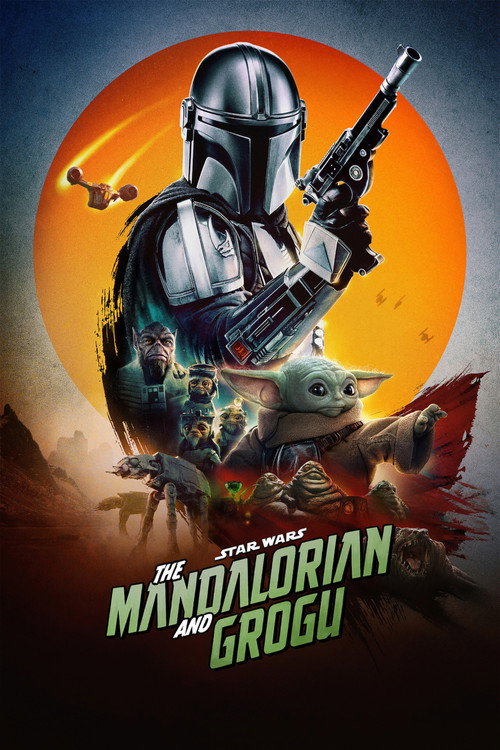
 United States