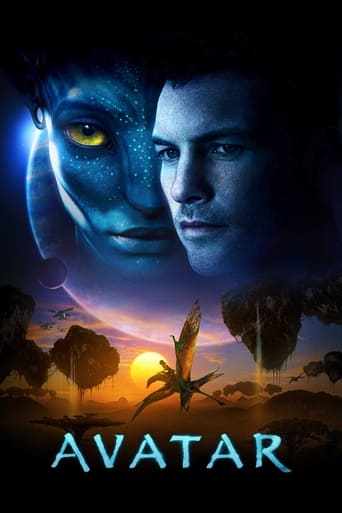
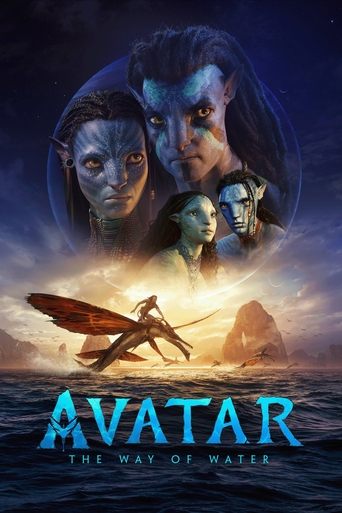
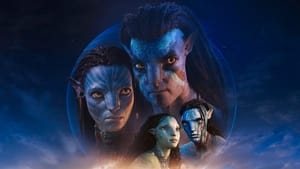
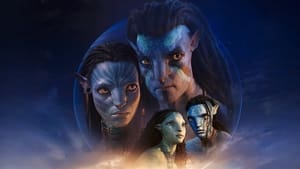
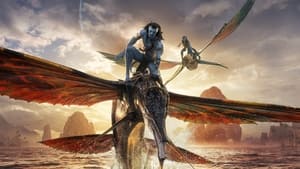
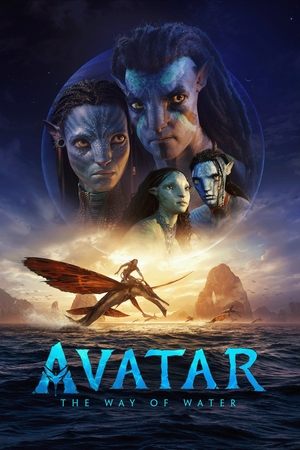
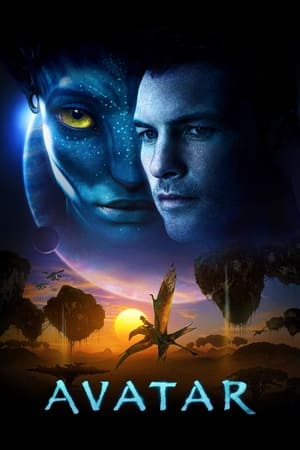
[73/100] The biggest problem with *Avatar: The Way of Water* is that so much of it feels like a cheap rehash. The [first *Avatar* movie](https://trakt.tv/comments/911103) had plenty of problems of its own. Not the least of them was the way the film felt built from the spare parts of other genre flicks. But if there was intrigue to a sequel, it was in the idea that there could be new and different challenges our heroes might have to confront. Having built this elaborate (if thin) world and settled the major conflicts for your protagonist and his adopted community, what wild and imaginative places would you take them from here?
The answer is, apparently, taking the franchise’s ecological themes too seriously and deciding to “reduce, reuse, and recycle” everything from the first film.
That begins with the shameless retcons. Hey, remember when Grace died in the first film and it was a tragic loss that our heroes had to reckon with? Well, no matter, because apparently she was pregnant with a carbon copy Na’vi daughter, despite there being zero indication of that in the last film.
Hey, remember when Jake and Neytiri fought and killed Colonel Quaritch in the first film, symbolically cementing Jake’s allegiance and repulsing the human threat? Well, no matter, because apparently Quaritch sent his DNA back to Earth to be cloned in a Na’vi body so he could return as the antagonist too, despite there being zero indication of that in the last film. (And it seeming antithetical to his worldview.) Oh yeah! And Quaritch also had a heretofore unknown kid, who was raised by the scientists on Pandora, and is now loyal to the Sullys and the Na’vi, despite there being zero indication of that in the last film.
These ideas aren't bad in and of themselves. The Sullys unexpectedly raising a sort of Na’vi messiah who carries the spirit of their dead friend has potential. Becoming your enemy in order to destroy them is a motif rife with meaning. And a young human boy who wants to be a Na’vi and resents his human heritage is a solid flip of the dynamic from the first movie.
But by god, the way *Avatar 2* arrives at these plot points is just so derivative and lazy. I like Sigourney Weaver too, but giving Grace a random messianic offspring is contrived at best. And despite the actress’s considerable talents, the seventy-one year old Weaver is never convincing at voicing a fourteen-year-old girl. I like Stephen Lang as well, but the advent of Blue Quaritch is the “Somehow Palpatine returned” of this franchise. The film only grazes the sci-fi thought experiment he represents and what it would mean to come back in an alien body and reconcile your identity with the man you were.
Most of all, it feels like writer-director James Cameron and fellow writers Rick Jaffa and Amanda Silver couldn't be bothered to come up with a new villain with new reasons to oppose our heroes in a way that would actually evolve the story. Instead, they rehydrated a bunch of freeze dried pieces from the first movie, in a way that smacks of an inability to move on.
Still, most sequels involve fudging things a little bit so familiar faces can come back to play. Some of these elements might be forgivable -- as excuses to bring back performers who were, frankly, the best part of the first film -- if only the rest of the movie had more of something original to offer.
* * *
Suffice it to say, *The Way of Water* regurgitates so many of the basic concepts from the prior film with only the most marginal new wrinkles.
Rather than imagining some new threat, *Avatar 2* just brings the RDA back to once again try to wreck the Na’vi and upset the natural balance of Pandora. Rather than finding a new story shape to explore, we’re back to another group of outsiders being rejected for their human ties, only to find themselves growing attached to their new homes and proving themselves worthy members of the community. Rather than finding new avenues of romance, we’re back to not one but two outsider boys falling in love with not one but two chieftain’s daughters. (At least they’re doubling down, I guess?)
Sequels are always a balance. How much do you break new ground versus bringing back what audiences liked from the first installment? It’s not an easy line to walk. But Cameron and company veer much too far on the side of reheating leftovers rather than giving audiences something original that *builds* on the prior movie, rather than just recapitulating it.
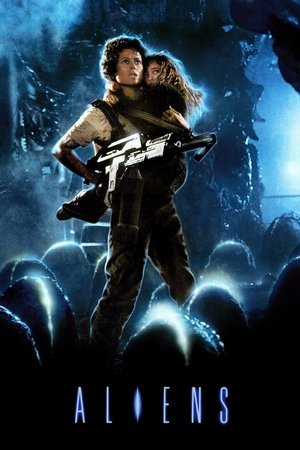
Heck, if you're familiar with Cameron’s wider filmography, much of *The Way of Water* feels like it’s built from the director’s favorite pieces of past projects. Characters in the film drown and are miraculously revived a la [*The Abyss*](https://trakt.tv/comments/330535). Characters rush from room to room and compartment to compartment to avoid rushing water on a sinking ship, as in both that film and *Titanic*. And once more, a motley collection of jerky space marines leap into this outsized situation, a trope that Cameron’s been deploying since *Aliens*.
Again, these elements aren’t bad in and of themselves. But the second Avatar film suffers from the same pathology the first one did. Despite having such theoretically novel concepts in play, *The Way of Water* offers audiences remarkably little that feels new or different and executes those ideas in about as paint-by-numbers a fashion as possible. Repeating so many of the same concepts only exacerbates those issues.
It also means all of the core problems from the first Avatar movie are all back too. The mishmash of indigenous cultures and practices and stereotypes represented by the Na’vi remains problematic. Viewers are again forced to endure painful, hand-holding voiceovers (without even the conceit of a vlog this time). Eighty percent of the characters are paper thin archetypes, forced to rely on a mixed bag slate of performances to make them sink or swim. And the vast majority of the dialogue is tin-eared and on-the-nose. With a stock story and so many reheated elements, you need extraordinary execution to elevate a film like this one, and Cameron and his team just aren’t up to it.
No one is less up to it than Sam Worthington, who returns as Jake Sully (now in fulltime dress blues), and he’s no better here than he was thirteen years ago. His faltering attempt at an indeterminate Northeast accent, his generic tough guy demeanor, and his overly labored, routinely unconvincing line deliveries mean the film’s anchor is a dud yet again. *The Way of Water* is more of an ensemble than its predecessor, which at least mitigates some of the impact. But the original albatross remains firmly around *Avatar*’s neck, with few, if any signs of improvement.
That is disappointing but perhaps not unexpected. You can hope for the creative team to learn from the mistakes of the first film. But when the first film makes a billion dollars, it’s naive to expect corrections. And yet, one recurring flaw that rears its ugly head in *Avatar 2* is truly surprising -- the fact that the visuals here are still a wildly uneven part of the film.
* * *
That's supposed to be the saving grace of these movies right? James Cameron may not be a master of bold storytelling, but he’s at least supposed to be a visual stylist extraordinaire. If these movies can't break new ground or give us quality drama with three-dimensional characters, they should at least give audiences the thrilling theme park ride these flicks are often billed as.
The problem is that how convincing, how impressive, and how out-and-out appealing the film looks on a scene-to-scene basis is the real roller coaster. When revisiting the first Avatar film, I strove to cut the film’s CGI imagery some slack. Sure, not every shot met the standards of photorealism, and the core designs still have some problems, but you can't reasonably expect even a cutting edge effects-heavy film from 2009 to look perfect to modern eyes. It would be unfair to do so.
No such grace can be extended to a film released today, when scads of other films have offered motion captured characters and fully digital worlds. *The Way of Water* aims high, and strives to achieve things in scope and quantity beyond its competitors. But what it’s doing no longer has the leeway granted when you're a pioneer in uncharted waters.
Suffice it to say, *Avatar 2* still has its high points in terms of its iconography. Some of the imagery is seamless, legitimately impressive, and in rare moments, even awe-inspiring. But much of it looks shockingly rudimentary, immersion-breakingly plastic, or once again uncanny. At times, the unevenness of it all makes you scratch your head over whatever supposed progress the production team made after nearly a decade and a half.
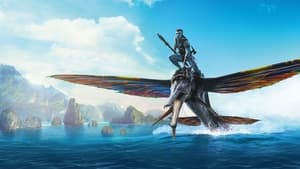
Perhaps the progress came via the film’s greatest asset, namely, the one in thef title -- water. The only immediate comparator for digital characters so convincingly splashing their way through the ocean’s waves is the fully-animated *Moana* feature. The degree of difficulty of conveying the vast amounts of liquid in a digital-heavy presentation is high, and yet there’s never a point where the submerged setting of so much of the film fails the eye test.
Likewise, many of the film’s most dazzling sequences take place under the sea. (Cue the singing crab.) Many of the problems that afflict the movie’s fumbling attempts at photorealism above the waterline float away beneath it. Peculiarities in weight and movement are less noticeable when everyone’s swimming. The way light reflects on skin or fur or faces is less intuitively off when that light is refracted through the water. And the design of the seascapes is often more stunning and artistic than what we get in the now-standard tech vs. nature monster mash on dry land. With those advantages, sequences like the Sully kids’ first experience exploring beneath the waves becomes the visual high point of the film.
But when forced to dry off, *Avatar 2* soon becomes laden with all the dodgy imagery of its predecessor. One minute, a Na’vi will emote and shrug and express themselves in a way that makes you forget you're watching a digital double. And in the next, the eyes will be glassy, or the gestures will be janky, or the movements will be awkward, and the abundant fakery of it all will be too glaring to ignore where it counts the most.
Sometimes you’ll see a CGI-heavy struggle and appreciate the craft, only for the editor to cut to a scene set with real people on a more tangible set in a way that's discordant and reminds your brain that what you saw a second before was phony. Even neat designs, like the jibbering crab mechs or fork-nosed whales, never quite pass muster as real, even if you can appreciate them for what they are.
What’s most surprising is that *The Way of Water* falters the most in its visuals during the big third act climax. The inevitable big climactic battle was the highlight of the first movie, a sign of Cameron’s talents as a purveyor of spectacle, if not quite a sterling storyteller. And yet, here, not only is the final set piece an overlong, jumbled mess with too many threads, but it’s often strikingly chintzy in many places. The efforts to rescue the kids, the whale rebellion, and the capsizing ship all come off undertextured, oddly-weighted, and poorly integrated with the real life imagery, in what ought to be the film’s showpiece stretch.
In the moment-to-moment visuals, *Avatar 2* is maddeningly inconsistent. That may be inevitable and at least a little forgivable for a film trying to maintain a high standard with nonstop effects shots over the course of three hours and change. But in its biggest, grandest showcase, the look of the movie is shockingly antiseptic and the virtual compositing is strikingly conspicuous when Cameron’s crew tries to mix real elements with digital ones in ways that fall well short.
As a visual buffet, the movie has a few dishes worth trying, so long as you acknowledge that you're getting breadth rather than depth. But as a billion dollar tech demo, the sequences meant to be most impressive are the ones likely to convince you that the technology is not yet ready for primetime.
Though maybe primetime is where this movie belongs.
* * *
*The Way of Water* is long -- too long really. (He says in the middle of a 4,000 word review without a hint of irony.) Not because there’s elements that need to be cut, even if there’s certainly scenes that seem indulgent or could be streamlined, but rather because Cameron and company try to stuff so damn much into this near-bursting frame.
Cameron supposedly built a T.V.-style writer’s room for his slate of Avatar sequels and it shows. There are scads of storylines stapled together here. Some of them have time to breathe. Others find themselves underfed. Some are clear hooks for later sequels. But all of them collectively feel like too much in an overstuffed movie that nevertheless leaves plenty of storylines dangling for another day.
You have the quick-fire rush of years where Jake and Neytiri build a family. You have the return of the RDA and the reveal that this time, they don’t just want to mine Pandora; they want to colonize it. You have Jake as a tough military dad trying to get his sons to listen to him. You have the brotherly relationship between his two oldest boys and who’s responsible for whom. You have the Sullys having to flee their home and hide with a sea tribe. You have Quaritch returning as a Na’vi, and he and Spider both feeling a certain way about their quasi-father/son connection.
The plotlines only balloon from there once the Sullys make it to their new destination. There’s an array of nigh-literal fish out of water stories of the “forest people” adjusting to their hosts’ way of life. There’s the RDA’s blue goons hunting Jake. There’s hints that Kiri has something special inside her and mysteries about her parentage. There’s Lo’ak befriending a whale and it causing controversy in their adopted home. There’s an entire extended interlude about Quaritch’s crew’s riding along with a private whale-hunting boat. And there’s scores of rivalries and budding friendships and light romances and so on.
Again, none of these are inherently bad. It’s just too much for a single movie to encompass. The different components feel like their own individual stories, and stitching them together often grinds the movie’s momentum to a halt.
Even if you can withstand the extended runtime (which also includes sections there for pure spectacle rather than plot) the film rarely feels like a cohesive whole. Instead, it’s a bundle of different plot threads that are, admittedly, somewhat woven together in the climax, but in a way that feels more like a rushed season finale than something truly cinematic.
To paraphrase Chris Rock, “I loved the second season of Avatar!” (And hey, go watch the airbender show instead, kids. Its second season is leagues better than this movie.) While cinema crusader Cameron would never deign to allow his bout of blue bombast be reduced to the sorry confines of television (where it would, admittedly be harder to find the budget to do all his tech demos), this story would be much better served in that format. It would allow the different story threads to stand on their own when they need to and connect when the time is right in ways that feel like a thrill instead of something forced by the fact that they’re crammed together into the same 3+ hour chunk.
What’s especially frustrating is that, buried in that twine ball of a narrative are some genuinely good ideas and solid plots, but something is lost when they’re all tangled together.
* * *
Many of the new story concepts *The Way of Water* pulls off are compelling on paper. However much Jake’s family moving in with a water tribe feels like a redo of his original involvement with the Na’vi, replete with a standard “You outsiders will never truly learn our ways! / Oh wait, you did!” transition, the writing team does manage to breathe some new life by broadening the focus to two families acclimating to one another instead of just one white savior.
That introduces more dimensions, with Jake trying to keep the peace given that their protection is at the pleasure of a neighboring chieftain, and the kids have a mix of crushes and rivalries and homesickness with their new teenaged companions. The problem, as always, is that so much of the material feels stock and facile, but by broadening the franchise like this, you can at least see the creative team trying to find new places to go despite repeating some familiar rhythms.
The movie is too scattered and wide-ranging to declare that it’s about just one thing. The reductive answer is that it’s about vague ideals like family. But in its best mode, it’s about kids coming into their own, and parents balancing a desire to protect and instruct with a recognition of capability and independence. As broad as the movie is, and as standard-issue as its growing pains narrative is in places, the emotional peak of the film plays in that space.
Lo’ak using what he learned from the water tribe to save his father’s life, teaching his dad and looking after him rather than the other way around, comes with catharsis given their clashes and mutual understanding when it means the most. And Kiri doing the same for her mother and sister, harnessing her connection to Eywa in a splendorous sequence that blends a familial love with an ethereal bent, grazes something greater and moving in a way that's all but absent in the rest of the film.
That's what’s most maddening about *The Way of Water*. In places, you see glimpses of the greater movie that this could be. At one point, Neytiri and Quaritch have a standoff. Quaritch has Neytiri’s daughter and Neytiri has Quaritch’s son. And there’s so many fascinating intersecting lines in that moment!
Quaritch bears a grudge against Neytiri because she killed his human self. Neytiri seeks murderous vengeance against Quaritch because he killed her eldest son. Quaritch feigns disinterest despite her threats against Spider arguing that, given his cloned body, Spider isn’t even his son. Despite Spider being a surrogate son to the Sullys, you buy that Neytiri might really be willing to kill him given her rejection of him as a human and a pretender to their people early on in the film. Kiri and Spider clearly care for each other and beg their parents not to hurt the other in this tense interlude.
It is a confluence of interests and relationships and bluffs and resentments that are legitimately complex and interwoven. You don’t know whether the better angels will win out for either side of the confrontation, and the layers of meaning, not just for these characters personally, but what it means to care about someone across cultures and through those we take in through love rather than blood, is outstanding. When a frustrated Quaritch relents to save his son, it adds dimension to the otherwise straightforward villain.
It’s a brilliant scene. The only flaw in it is that it makes you wonder why a movie capable of achieving something this complicated and rooted in character is willing to settle for the most basic, bottom of the barrel material elsewhere.
* * *
So much of the writing for *The Way of Water* does the job, but in a way that feels mechanical and without earned sentiment. There’s no better example of that than in the death of a mama whale. The script wants to convey that Quaritch and his commandeered whale-hunters have committed a great wrong. So they have them kill a whale who is pregnant with her calves. To try to make this more personal, we get a scene where the Chieftainess, herself pregnant, reunites with the whale like an old friend and the two converse for a minute about what it means to carry their babies and their happiness at coming together again.
I’m not knocking the scene, necessarily. It’s fine, and it accomplishes what it needs to. A character we know gives the slightest bit of shading to a character we don’t, so that when the bad guys kill the mama whale, it’s theoretically more impactful than if some random henchman just yelled “We got the mother!” off the side of a boat.
The problem is that it’s all just so slight and obvious. Despite having none other than Kate Winslet on board, the conversation between her and the whale is full of the usual cliches and doesn’t feel real. The attempt to have a tertiary character boost a two-scene character into something important feels shabby. And the whole sequence plays out like a check-the-box exercise, some necessary scaffolding for the next big set piece, rather than something rooted in genuine emotion.
There’s not a host of obvious plot holes or failures to set things up, narratively or emotionally, here. Instead, the script comes off like the stereotypes of Soviet architecture: functional but soulless. Almost everything is superficial, just another trope-heavy interlude until the next bit of tech-heavy excitement.
And even that tech-heavy excitement becomes convoluted and exhausting. At one point, in the big climactic clash, the Sullys’ daughter declares that she can't believe she’s been kidnapped again, and I couldn't either. The hash of a clash between Jake’s allies and Quaritch’s confederates goes on and on and on and on, with who gets rescued, who gets to help, and who gets to sit on the sidelines feels driven by randomness and plot convenience rather than anything organic to the story. What should be the high-octane and emotional crescendo of the film is, instead, a sagging, soggy mess.
* * *
I’ll admit that I’m a little mad. (You *can* put in the newspaper that I got mad.) I’m not normally bothered by vacuous but shiny blockbusters. They are a cost of doing business in Tinseltown. There are plenty of films that make beaucoup bucks without having much in the way of deep artistic merit. For every film like *Barbie*, which is certainly commercial but is also endlessly creative and has something to say, there’s a dozen Transformers sequels and Fast and the Furious follow-ups and Jurassic Park reboots that clog the top grossing list without offering much more than bare spectacle.
That's okay! Popcorn movies have their place. While I’d prefer that there be a better correlation between a movie’s quality and its financial success, and though I’d like it if populist fare had at least *something* to show for itself creatively, the world at large is not built for inveterate film nerds, and Hollywood isn’t either. That’s probably as it should be.
But why does James Cameron somehow get a pass for his doses of hacky blue nonsense when all those other comparable flicks are largely sneered at? Why does a movie that should probably be wedged somewhere between a Michael Bay transforming robot movie and the kind of superhero flick that Serious People disdain instead get Oscar nominations for Best Picture?
*The Way of Water* isn’t a bad movie. It’s fine, if jumbled, blockbuster fare. That's all that it needs to be. And yet, given Cameron’s past bona fides, an onslaught of cheap shtick with lazy resurrections, a continuous array of wildly uneven visuals, and a car crash of different storylines gets treated as Something Important that is somehow worthy of serious critical appraisal. And I just don’t get it. Is it the director’s reputation? The fancy tech? The vaguely laudable message? It boggles the mind.
I don’t mind that these movies exist. I watched stuff like this on Saturday mornings in my childhood, and there’s a place for big budget fireworks fests with the faintest patina of substance to keep you occupied between set pieces. *The Way of Water* isn’t awful. It’s a standard issue big budget genre movie, with heaping doses of spectacle and overblown emotions and enough signposting that even if you fall asleep for a third of it, you can catch what’s going on.
But why, when James Cameron’s at the helm, do we have to pretend that such releases are some kind of artistic achievement? Why can't we admit that, if you’ll pardon the expression, this kind of movie is splashy but shallow? Why is a film like *Avatar 2* -- with its stock stories with generic execution and oft-janky visuals -- given a pass among the people who otherwise turn up their noses at populist fare? Most importantly, when are we, as the movie-going public at large, going to admit that the King of the World has no clothes?

 Plex
Plex  Kodi
Kodi  Stremio
  Jellyfin
  Netflix
  Disney+
  Prime Video
  HBO Max
  Trakt
Trakt  TMDB
TMDB  Letterboxd
  IMDb
IMDb  Simkl
Simkl  TVTime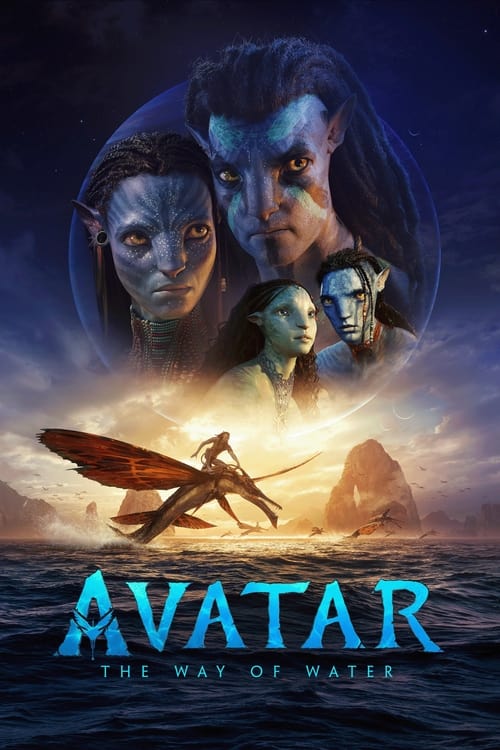
 United States