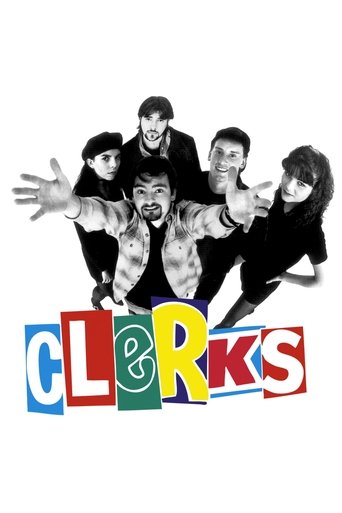
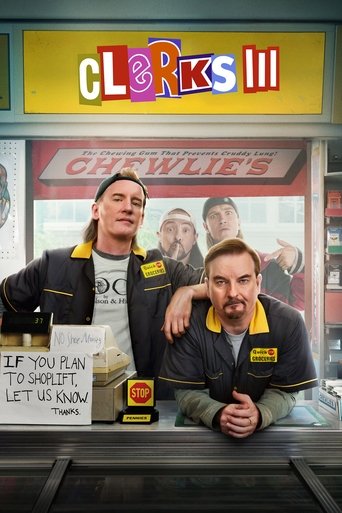
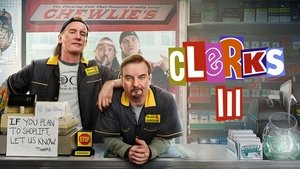
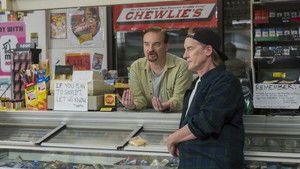
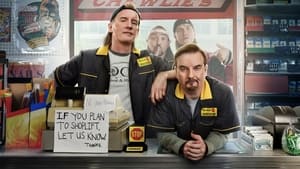
[7.0/10] The boon of the original [*Clerks*](https://trakt.tv/comments/794234) film is that it felt real. Despite the amateur production and unpolished filmmaking, writer-director Kevin Smith injected enough of his real life experiences manning the counter at his local convenient store, and enough of his real struggles with what to do with his life, that the “truth in his art” shined through and made the movie into a gem of the 1990s indie film scene.
The irony is that half of the same approach nearly dooms *Clerks III*, and half of the same approach nearly saves it.
The half that almost dooms the late sequel is Smith once again mining his external challenges, the trials and travails of life, for laughs and/or plot points. Only for *Clerks III*, Smith departs from channeling his experiences working at the Quick Stop and instead begins channeling his experiences of...making the first *Clerks* movie.
It’s part and parcel with the increasingly meta turns Smith has made in his vaunted View Askewniverse since the days of [*Jay and Silent Bob Strike Back*](https://trakt.tv/comments/826559). To the point, when the still irascible Randal Graves suffers a heart attack, he resolves to stop merely commenting on movies from his video store perch and decides to make one himself, thereby seizing the chance to tell *his* story.
That's not a bad idea, in principle. Randal is one of the best cinematic avatars for Gen X snark ever made manifest. The idea that the young man who once seemed content with his choices, however provincial his circumstances, is now older, looking back on his life, and wanted to take a more active role in it, flips the dynamic between him and Dante in the first film. And it serves as an interesting commentary on both the “smartass slacker on the sidelines” archetype that Smith was once a mouthpiece for, and the slice of the fandom that wants to comment and criticize but never actually *do*. (Not that I’d know anything about that, naturally.)
But in practice, the results are underwhelming at best. Pairing Smith’s real life experiences as a young man making a DIY movie at his workplace and his real life experiences as an older man suffering a heart attack makes for an awkward marriage. Mining your life for meaning is the writer’s gold, but the two parts Smith channels don’t quite fit together, and it leaves much of the “Let’s go make a movie” material, once born of young hunger and now fueled by wistful, near-death resolve, seeming miscalibrated.
More than that, though, the choice suffers because it mostly becomes an excuse for Smith to load up *Clerks III* with rank fan service. (Another choice that's sadly marbled through the View Askewniverse films since *Strike Back*.)
Some of that is inevitable. You can't make a late sequel without feeding at least a touch of nostalgia. And if Smith had largely left it to the endearing recapitulation of the first movie’s rhythms in the opening montage -- set to the most perfect, earnest, and (given the film’s ending) retroactively moving use of My Chemical Romance’s “Welcome to the Black Parade” imaginable -- it would have been charming, and it would have been enough. Instead, much of Randal’s story amounts to an extended exercise in “Hey, remember this thing?”
Suffice it to say, if you wanted to see key scenes from *Clerks*, performed by the same actors nearly thirty years later, with little in the way of new twists or wrinkles, *Clerks III* certainly has you covered. Sure, there’s some novelty to seeing the familiar faces doing their familiar shtick again. But without some new angle, scene after scene of bare nostalgia gets old fast. Rather than offering some fresh insight on the oddballs who once populated the quickstop, or at least some new jokes, Smith and company are content to reheat dishes from three decades ago and call it a day.
The purportedly new material that reimagines the behind-the-scenes moments of *Clerks* is no great shakes either. Perhaps if you don’t already know the “making of” stories behind Smith’s first film -- from retrospective articles, or Smith’s anecdotes from his live shows and podcasts, or even just the twin pillars of Wikipedia and IMDb -- then some of the film’s nesting doll movie-about-making-the-movie bits might land with more force. But considering this one already feels tailored for die-hard fans, most of those scenes play like mild dramatizations of stories that have long been chronicled already, recreated without the same zing thirty years after the fact. So ultimately, they elicit little reaction beyond, “Hey! It’s that thing Kevin Smith talked about!”
Oddly enough, the attempts at new comedy don’t fare much better. In a disappointing turnaround, gentle Elias (who was stealthily the funniest part of the last movie) is bereft of laughs as the devoted Christian-turned-Satanist who still reports to “Mr. Dante.” The bit’s less funny and more sad when Elias is a stunted adult who never matured, rather than a naive teenager in the care of his slacking elders. And the riffs on his turn to the darkside can't manage much beyond tired gags and costume changes that top out at “occasionally chuckle-worthy.”
Ironically, the few new spins on old material do still work. Randal riffing on *The Mandalorian* and relating to life through Star Wars is still amusing and on-brand. And the fact that he talks about the show to an oblivious doctor played by Star Wars’ own Amy Sedaris (a ringer who is the funniest part of the film) is one of the few bits of meta humor that lands. Plus hey, Dante and Randal retreating to the cooler and remarking that it’s “Hoth cold” back there is a heartening homage to the best episode of *Clerks: The Animated Series*, and the kind of brief and subtle nod to past projects that should have been the currency of *Clerks III* instead of conspicuous, wholesale recreations of past scenes and sequences.
Unfortunately, *Clerks III* also features the same self-indulgence that's infused the last several Jay and Silent Bob films. Thankfully, most of the Consistent Collaborator Cameos from Smith’s pals and partners are confined to one sequence where the team is auditioning actors for the movie, and it’s brief and amusing enough. But once again, Smith involves his wife, his mother, and his daughter in the movie in strained ways that wink at their real life relation to the director. And Silent Bob himself being the director of photography for Randal’s movie and waxing rhapsodic about the reasons to shoot the film in black and white is too cute by half.
Suffice it to say, much of *Clerks III* feels handicapped by a constant need to worship at the altar of *Clerks I* and invoke as much of Smith’s past filmography and fourth-wall-nodding shtick as possible. Rather than letting the third (and probably final) film in the Clerks trilogy stand on its own, this latter day feature frequently feels like it only exists to lionize the movie that started it all, shamelessly invoking almost every routine from Smith’s first at-bat.
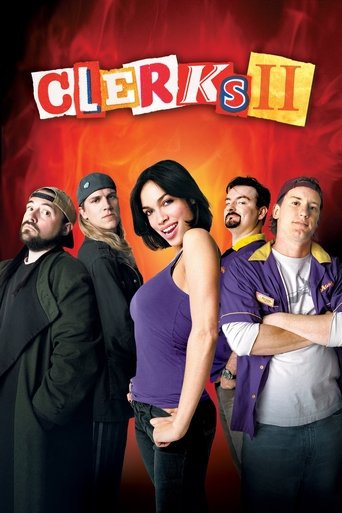
[*Clerks II*](https://trakt.tv/comments/841388) has its flaws, but one of the most admirable things about Smith’s first attempt at a follow-up is that it built on the first *Clerks* movie, without just trying to recreate it. The second volume in the story of Dante and Randal still focused on life in a thankless retail setting, but changed the locale, evolved the kind of choice Dante was facing, found a new set of jokes to tell, and flipped the takeaway for the film’s protagonist. Whatever you may think of the 2006 release, which already felt like a late sequel at the time, it dared to be different, in a way that seems all the more laudable in the shadow of *Clerks III*’s shameless nostalgia fest.
It’s both ironic and appropriate, then, that the best parts of *Clerks III* are the scenes and stories that build on the events of *Clerks II*.
That's the funny thing about the movie. While everything in Randal’s half of the movie is centered on reconjuring what came before, Dante’s half is about how he’s still haunted by all of it. And in lieu of channeling the external challenges Smith faced when making his original film or suffering a medical emergency, it does better by mining the internal struggles of looking back on your life, the people you love, and the people you’ve lost.
Smith makes the tough but admirable creative choice for Dante’s girlfriend, Becky, and the child she was carrying, to have been killed by a drunk driver before their lives together could even begin. Dante carries that burden with him, understandably still reeling from the loss sixteen years later. All of the humble joys that were his choice in *Clerks II* were snuffed out before he could enjoy the beauty and bliss of them, a loss that is still with him today.
It makes for an achingly real contrast to the goofy metahumor of Randal’s story. Rather than merely celebrating the successes of the past Clerks movies, Dante’s storyline makes the bolder choice of pushing the character in yet another new direction. There’s a greater depth and poignancy in that, a willingness to take Smith’s original avatar to different, tougher places, while the rest of the movie is content to re-offer the soothing balm of what the audience already knows. And despite the tonal differences from the rest of the film, *Clerks III* handles the starker material well.
While a bit of a cheesy device, bringing Rosario Dawson back as the voice in Dante’s head, with Becky encouraging him to move on and live his life, leads to the right blend of charm and heartbreak. The unexpected chemistry between the characters abides, but so does the sense of beleaguered Dante barely holding it together amid the pain of losing the thing that made him whole.
Smith and company commit to that heartbreak and an authenticity is Dante’s hurt that's all but missing in the rest of the film. Sure, it’s fun to see him play the put upon “producer” supporting Randal’s latest zany scheme, and heartening to see him reconnect with Veronica and take stock of where their lives have gone since we last saw them together in 1994. But the crux of Dante’s story is that he was robbed of the happiness he never expected to within his dead-end job in a small New Jersey town, and has never fully recovered from something so precious being stolen from him right when he was on the cusp of living his best life. It is the opposite of fanservice; an illustration of the way life isn’t always good or fair, and the rush of years offers as many bracing blows as it does happy endings.
The collision between his and Randal’s storylines results in the best scene of the film. A return visit to Mooby’s to recreate a few key moments from *Clerks II* is triggering for Dante, and leads him to get drunk as a coping mechanism. The lamentable liquid courage that results, combined with some particularly self-centered behavior from Randal, leads to a tremendous subversion in a movie otherwise slavishly devoted to merely reheating the past. Randal’s attempt to recreate his climactic critique of Dante from the first *Clerks* movie results in Dante going off script and turning the tables, dressing down Randal with no less force or cutting insight than his counterpart did back in 1994.
My god, Brian O’Halloran just nails the scene. If there’s a reason to watch the Clerks trilogy in succession, it’s to see O’Halloran go from being a relatable but stilted performer in the first movie, to the kind of actor who can deliver such a vulnerable, volcanic performance in the final one. Smith writes him the kind of raw, achingly human monologue that was the stock and trade of [*Chasing Amy*](https://trakt.tv/comments/806311). And O’Halloran makes a meal out of it, conveying a sense of utter exasperation, woundedness, and irrepressible hurt that breaks your heart every second he’s on screen. It’s a scene good enough to single-handedly justify the film.
That's good, because the whole movie rests on it. Dante’s rebuke is the dressing down of Randal Graves for all of the crap that he puts Dante through that the man’s had coming for nearly thirty years. It is a damning takedown of the snarking slacker persona Smith’s movies helped enshrine and a harsh critique of the kind of life that approach ultimately gets you. Most of all, it is the movie’s barest statement of how, in a story where Randal is egotistically out to capture his own life on film, minimizing Dante’s role in it, Randal’s choices forced Dante to relive those events -- a constant, gutting reminder for Dante of how much he’s lost. Randal obliviously rubbing his best friend’s nose in his greatest tragedy is an unwitting act of cruelty, and *Clerks III* earns the reckoning between the two stalwart friends.
Hell, in a movie full of shameless, soulless repetition from *Clerks I*, Smith even manages to find an affecting way to invoke Dante’s famed remark that, “I’m not even supposed to be here today”, primed and twisted for maximum poignance. It’s the scene that does the best job of recapturing the magic that began with the first *Clerks* movie, and the irony is that it’s because it’s the scene most devoted to subverting and diverging from what came before.
The darkness in that confrontation justifies the light that follows. I’ll confess, the ending of *Clerks III* is a little muddled, but it gets by on the earned sense of heart between these characters, and the good will Smith and the View Askewniverse team have generated between the first *Clerks* film and the (presumable) last one.
There is power in Randal taking his best friend’s word to heart, much as Dante did twenty-eight years earlier. While the film sets it up, Dante suffering a heart attack not long after Randal did is a little contrived. But it’s worth it because while Randal’s near-death experience, if anything, only made him more focused on himself, seeing his best friend on death’s door spurs Randal to step outside himself and see how important Dante has been in his life.
It is, in its own way, a version of the same lesson from [*Jay and Silent Bob Reboot*](https://trakt.tv/comments/871287), that being a part of someone else’s story can be just as important as telling your own. Granted, Randal seemed to understand his best friend’s importance well enough by the end of *Clerks II*, but it’s easy for such epiphanies to fade over the course of a decade and change. The self-centeredness Randal showed in making Dante his put upon producer and side dish in the story of his life makes it all the more meaningful when he comes to Dante on his death bed, and shows him the movie Randal made -- Dante’s story.
There is something restorative in that. The final gift that Randal gives his dear friend is moving -- a cinematic vision of their lives together that lets Dante see the beauty in the life he lived, and not just feel the pain of the life he didn’t. Dante watching clips from the first two Clerks movies in his theater of the mind doesn’t make much sense if you stop try to parse it, but in the impressionsitic tones of a man reflecting on the best of parts of his life and his bonds, and a director reflecting on the same through his art, the affecting splendor if it trumps any logical stretches. That it gives Dante enough peace to let go, to reunite with his lost love, to accept his life as a good one, is in a poignant way, a happier and more earned ending for the character than anyone could ask for.
The wrap-up is a little tidy, back to the fan service and back-patting that weighed down the rest of the picture as it points the surviving characters toward their own successes and happy endings and repeated rhythms from long ago. But it’s Dante’s story -- his suffering, his peace, and his end -- that make *Clerks III* worthwhile. In a movie that bends over backwards to incorporate every real life bit of the making of the first film in Smith’s oeuvre, and the various misadventures of his life, it is the hardship, the catharsis, the emotions in the tougher and more challenging sections of the film, that ultimately feel the most real.
That sort of emotional truth carried Smith’s shakier early efforts into something recognizable and profound, and it is what justifies his return to the Quick Stop, and manages to make *Clerks III* a worthy capstone for this storytelling universe, and the characters who began it.

 Plex
Plex  Kodi
Kodi  Stremio
  Jellyfin
  Netflix
  Disney+
  Prime Video
  HBO Max
  Trakt
Trakt  TMDB
TMDB  Letterboxd
  IMDb
IMDb  Simkl
Simkl  TVTime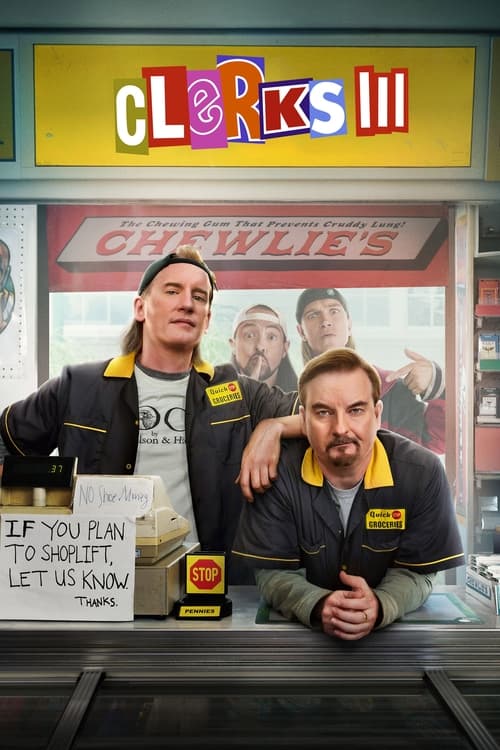
 United States