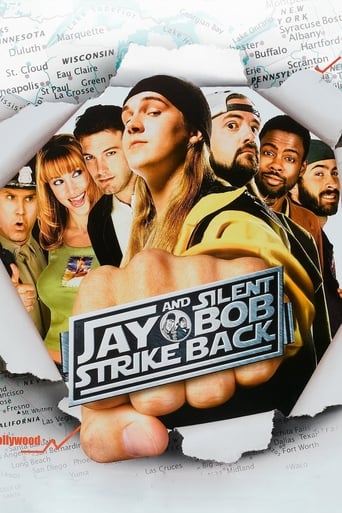
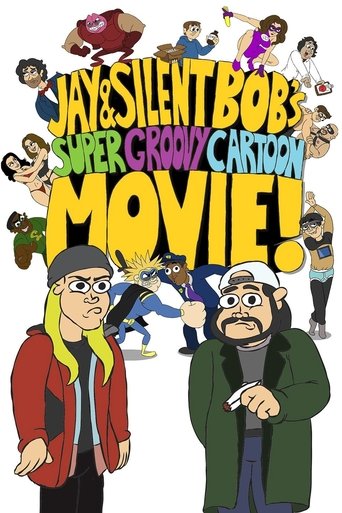
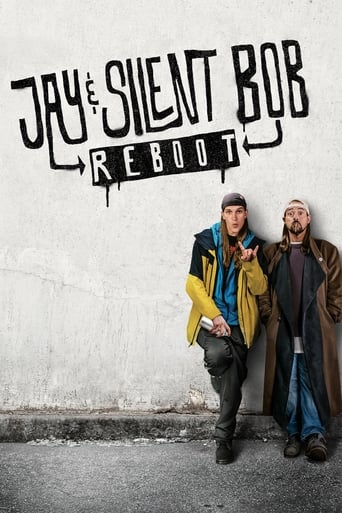
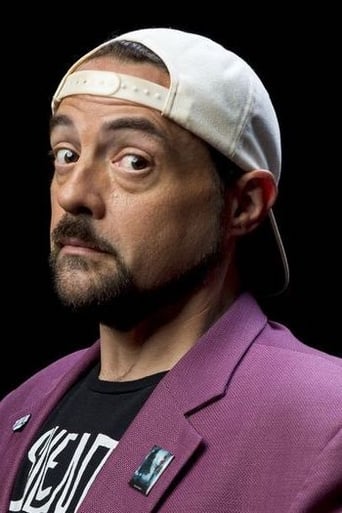
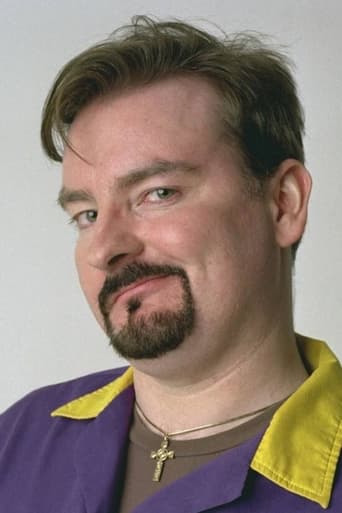
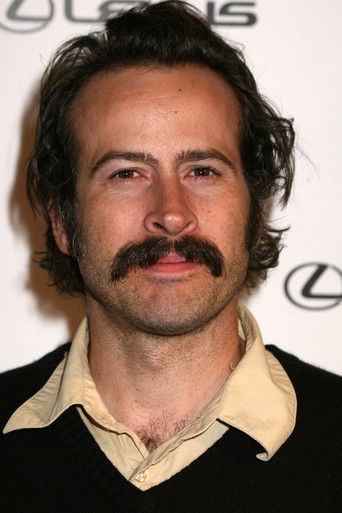
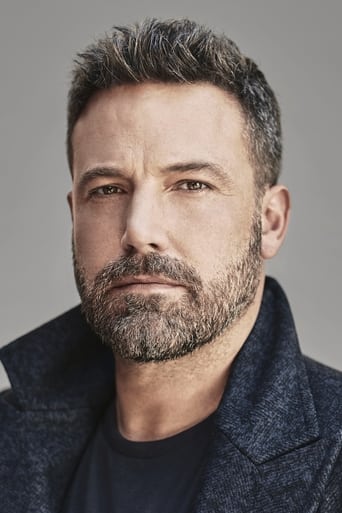
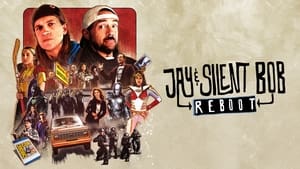
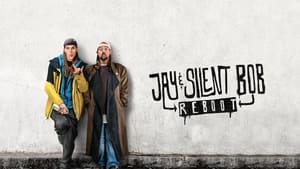
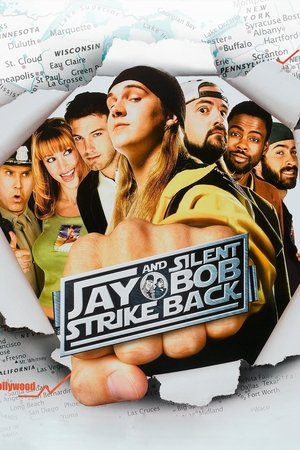
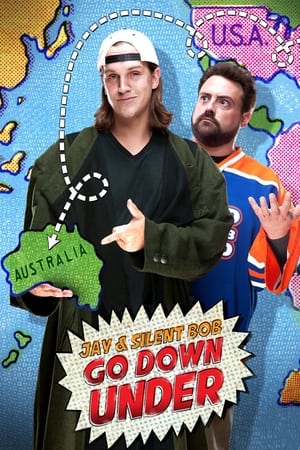
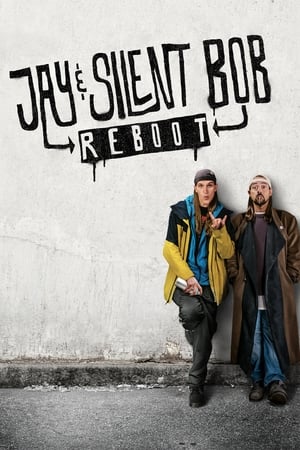
[7.0/10] *Jay and Silent Bob Reboot* won me over, but it was a battle. The last thing the world needed was a sequel to the execrable [*Jay and Silent Bob Strike Back*](https://trakt.tv/comments/826559), the dimmest low light in writer-director Kevin Smith’s famed View Askewniverse. (Give or take the titular duo’s seemingly non-canon and borderline unwatchable [animated film](https://trakt.tv/comments/846960).) The reboot carries over the most tiresome excesses from *Strike Back*, with a surfeit of blatant fanservice, meta nonsense, puerile gags, tepid showbiz satire, and shameless creator indulgence. You could be forgiven for writing off this nearly two-decade follow-up as the same shovel-load of dreck offered up by the last Jay and Silent Bob headlining feature.
But around the half-hour mark, the reboot develops a marvelous thing that *Strike Back* was sorely lacking -- a point. *Jay and Silent Reboot* is *about* something, namely what it means to Jay to realize that he has a daughter, and more generally how it changes your perspective on your life and whose story you're telling when you become a parent. And against all odds, that animating theme makes all the difference.
When I wrote about *Strike Back*, I complained that, however entertaining Jay and Silent Bob are as side characters, the problem is that they don’t have the depth to sustain a feature length story. I’m exceedingly glad to be proven wrong! In arguably the Askewniverse’s biggest surprise, Smith and company give none other than catchphrase-spouting, Jersey jester Jay an honest to goodness character arc. And even more surprising, it’s the best part of the film.
The revelation that unbeknownst to Jay, he has a lovechild with Justice (his passing paramour from *Strike Back*) almost immediately changes Jay and gives him character traits beyond horniness and weed that manage to land with surprising force. Jay sees his typical antics reflected through his daughter, and it gives him a new perspective. The way the foul-mouthed former stoner is suddenly aghast, chiding his child for doing and saying the same sort of things he did and said back in the days of [*Clerks*](https://trakt.tv/comments/794234) is a knowing choice from a writer who’s clearly experienced the same. There’s something well-observed about how Jay watching a funhouse mirror version of himself causes him to see beyond himself and reflect on his antics for (arguably) the first time.
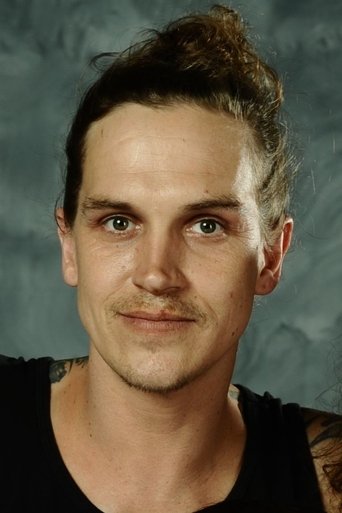
Watching the otherwise no-account pot dealer grapple with that realization and fret over what kind of father he should be is the most endearing Jay has ever been. (With an honorable mention to his sideways chivalry toward Bethany in [*Dogma*](https://trakt.tv/comments/806942).) This is a human, sympathetic side of a character who, to this point, has been a walking joke machine, and that gamble pays off. Jason Mewes is up to the task, finding a blend between the character’s traditional motor-mouthed trash-talker persona and that of a simple but earnest numbskull trying to do right. The fact that this offers a decidedly different side of the debauched stoner without it ever feeling out of character is an achievement in and of itself.
Much of that owes to Mewes’ scene partner. One of my biggest criticisms of the reboot is that it is painfully indulgent for Smith and his cohort. In a film already trying to do a ton, I don’t know why we need Smith playing himself in addition to Silent Bob, with cameos from Smith’s real life wife, and Mewes’ real life daughter, and everyone the director’s ever hosted a podcast with, and tons of other nods to the man’s real life that have little, if anything, to do with the story at hand. Look, it’s lovely to want to work with your friends and family, but surely there are cheaper ways to make a home movie than to fund it for a feature film release.
But despite some corny lines acknowledging the nepotism of it all, I can't complain too loudly because the director’s daughter, Harley Quinn Smith, gives the best performance in the film. She rises to the occasion as Jay’s daughter, Milly, who has long struggled with the absence of her father, and the younger Smith comes to play.
Milly makes for a great foil to Jay, one who can take all he has to offer and dish it out twice as strong, which is the right note to play for something that would be startling and even bracing for the two-bit dealer of a dad. She delivers her father’s dialogue with aplomb and, most importantly, manages to sell the emotional moments in a way that punches above the material and makes you buy into something real amid a torrent of silliness and fanservice. The family-casting inspires eye-rolls, but I can't deny the success of the results, or the added resonance from Smith enlisting his real life daughter in a story championing the epiphanies of fatherhood.
Unfortunately, the movie needs that strong of a performance and the force of the drama because so much else here is the pits. The humor of the film isn’t quite as bad as the “scrawled on a middle school bathroom stall” level of juvenalia on offer in *Strike Back*, but it’s no great shakes either. Jokes about nicknaming a guy after pubic hair wigs, or a chicken restaurant called “cock smoker” are emblematic of a movie happy to offer bare vulgarity without the cleverness, when Smith used to be able to provide both.
That may be table stakes for a Kevin Smith film in the present day, but even apart from the standard sophomoric shtick, the comedy here isn’t much to write home about. The constant winking references to Smith’s non-Askewniverse work are tiresome. The script’s tepid and superficial satire of Hollywood's excesses and cape flick focus is no more incisive now than it was eighteen years earlier. And it may be a novelty to see Smith offer a spirited rendition of Alec Baldwin’s monologue from *Glengarry Glen Ross* to a herd of Klansmen, but it’s not particularly funny. (Though hey, the running gags about “hater tots” got me, so it's not a total loss in the humor department.)
Throw in a third act cluster fuck that smashes together all the film’s worst cameo-cramming and self-indulgent excesses, alongside a muddled and misguided spin on the vaguely topical “Russian interference” angle, and you have a ton of material -- both narrative and comedic -- that feels wholly misaimed.
That's exacerbated by the fact that *Jay and Silent Bob Reboot* is positively awash in fan service. I enjoy a good return appearance as much as the next guy, but Smith and company reach the point of excess in bringing back prior Askewniverse characters in the first thirty minutes and then just keep chugging.
So here’s a lame talking head interlude from Loki, and Diedrich Bader as the guard from *Strike Back* and Rosario Dawson as a new character, until you're rolling your eyes rather than cheering for old friends. Seeing one or two familiar faces pop up for a minute is pleasant. Getting dozens of them machine-gunned at you one after the other is exhausting. And most of the material the script gives them is cheesy and unavailing in its own right. I wish Smith had saved more of that stuff for the end credits, which is the perfect place to see the two teens who bought pot from Jay in [*Clerks II*](https://trakt.tv/comments/841388) again, and would be a better fit than shoehorning the bric-a-brac into the movie proper.
In the same vein, Smith’s films have always employed comic book references, and that's long been part of their charm. But by the time you have Melissa Benoist as a Supergirl knockoff, and Val Kilmer as an ersatz Batman, and Chris Hemsworth popping in as a hologram after Milly waxes rhapsodic about “Thor’s hammer”, the cameos start to feel too cute and detract from the outsider energy that's long buttressed the director’s work.
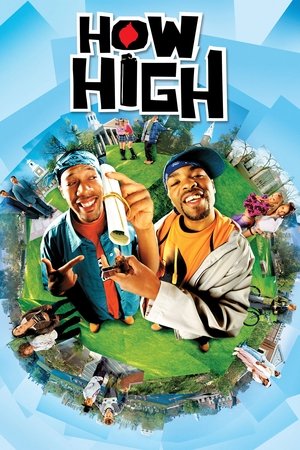
That said, as a bit of a victory lap for stoner comedy, the reboot is oddly endearing. Tommy Chong’s turn as an Alfred type is pandering as hell, but also feels like a benediction. And my goodness, Method Man & Redman nearly steal the show when they play off their 2001 weed flick counterparts in Jay’s dream sequence, with arguably the funniest turn in the film. (Dare I suggest that maybe the world could benefit from a *How High* reboot?) This stuff is no less hokey, but damn if it isn’t effective.
And while the conspicuous collection of all Smith’s usual players in the same had little in the way of redeeming qualities in 2001, the feeling is a little different nearly twenty years later. There is merit and power in seeing these folks come together so long after Smith’s original films made their mark. This has the spirit of a family reunion, and given Smith’s in-story and real life near-death experience, it makes it easier to forgive some of that “getting the old gang back together” vibe here than in *Strike Back*.
Maybe it’s just because, amid all the pandering nonsense, Smith somehow manages to present a wholesome and satisfying epilogue to his best film. As happy endings go -- seeing Holden McNeil from [*Chasing Amy*](https://trakt.tv/comments/806311) grow and mature; develop a lifelong respectful friendship with Alyssa Jones; and realizing that the “girl who loves him” he’s been chasing after is a daughter, not a girlfriend -- is almost as good as you could ask for. Seeing Alyssa healthy and fulfilled in a relationship with another woman is just as good. And the pair as platonic co-parents of a daughter they both adore, while working together creatively, hits the right notes. Some of the signposting is a bit too heavy-handed, but it’s hard to gripe too loudly about the fanservice when it delivers as strong a postscript as this.
More to the point, the choice isn’t just a sop to longtime viewers; Smith uses Holden as his mouthpiece to deliver the film’s key lesson to Jay and the audience. Despite all the shallow showbiz-skewering flotsam the director deluges the film with, the poetry of children as your personal “reboot” is as sweet as it is silly. Holden’s monologue about realizing that becoming a parent is realizing it’s not your story anymore is genuinely touching and insightful. And the affirmation of passing the torch to a new generation, rather than railing against “youth and diversity” and change is a laudable message from a onetime king of the nerds.
So when Jay takes his old pal’s life lesson to heart, when he works to help Milly achieve her goal even when it’s directly opposed to his, when he strives to be a good dad to the daughter he never knew he had, it doesn’t just land; it elevates the film higher than it has any right to be. Those choices evince a director who, despite falling prey to many of the same bad habits he had nearly two decades ago when Jay and Silent Bob struck back, has himself matured and has wisdom to share from the perspective of a loving father, not just an aspiring young clerk.
*Jay and Silent Bob Reboot* is still a trial for much of its runtime. Smith’s “throw it all in the stew” mentality for one more mega-Askewniverse movie results in a cluttered, self-indulgent, over-the-top mess in places. And yet, within that questionable cocoon lies the unexpected story of the creator’s thinnest character becoming, well, a real character, when he becomes a dad, and learning whose story it becomes with the passage of time. That's more than I expected from another Jay and Silent Bob romp, and despite the film’s drawbacks, makes it worth watching Jay, and Smith, revive, reimagine, and reboot themselves, with all the struggle and satisfaction that entails.

 Plex
Plex  Kodi
Kodi  Stremio
  Jellyfin
  Netflix
  Disney+
  Prime Video
  HBO Max
  Trakt
Trakt  TMDB
TMDB  Letterboxd
  IMDb
IMDb  Simkl
Simkl  TVTime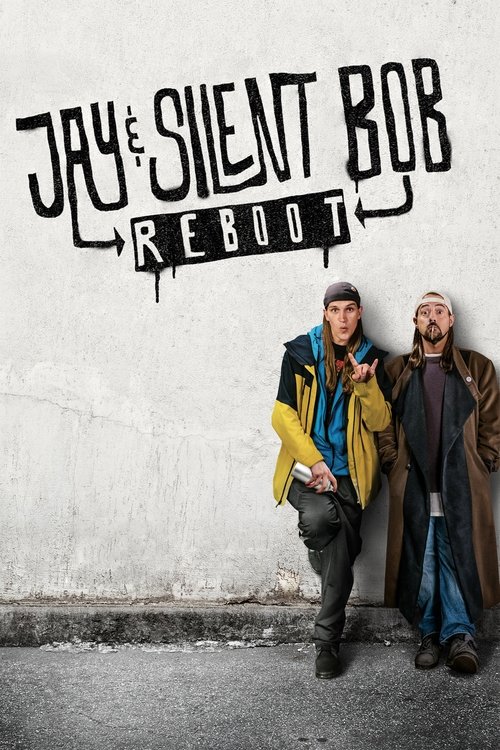
 United States