[8.1/10] There’s a weird thing about the seventh episode of a season. For whatever reason, it tends to be the place where shows pull the trigger on big reveals or kick off their major storylines for a season after some number of teases and hints. I tend to think of show’s like *Buffy the Vampire Slayer* in particular, which would spent six episodes of characters warning “from beneath you, it devours” before revealing what exactly “it” was, but it’s a sort of seasonal pacing plenty of shows follow. It might be a remnant of the days when new series would receive 13-episode orders, meaning a dramatic unveiling was in order for the halfway point of what might be the entirety of the show’s run.
*Westworld*, on the other hand, is more than two-thirds of the way through its first season, and yet decided to stick to that same seventh episode charm. Whatever the reason, “Trompe L’Oeil” raises the curtain on any number of mysterious plot points and developments the show seemed to be saving for a rainy day. Plans that were once unknown are brought out into the open; questionable motives are exposed, and secret identities are revealed.
The dullest of these is the (attempted) culmination of the corporate backstabbing, but at least the scenes with Hale and Theresa finally shine some light on what the mysterious “board”’s larger goal is, and what the conflict with Ford is. The company that bought Westworld wants the IP -- presumably the patents and code and other protections behind the ability to create robots that can pass as human -- of the park, and Ford won’t let it leave his little enclosure.
So Hale and Theresa’s satellite link-up is, presumably, transmitting that sort of proprietary data so that it can not only get out of the park, but be preserved in case of disaster. Ford doesn't keep back-ups, knowing that the IP is his only leverage, and so Hale is worried that if they don’t convince Ford to step aside gracefully of his own volition, that he’ll wipe away everything valuable about the park with the wave of his hand.
I don’t love the storyline, since it seems to set up a pretty flat old-timers vs. evil corporateer setup, but it’s at least nice to know what the conflict between Ford and the board, in a way that lets us know each side’s motivation and put everything that’s come before into context. It’s something the show has been sorely missing until now.
It seems like “Trompe L’Oeil” exists to expose those personal motivations. We see Maeve declare her intentions to find a way out of this place. Beyond just her awakening, which is already riveting, and the pain and anger in her eyes when she sees her compatriot from the saloon robo-lobotomized, this gives Maeve a clear path, a clear want, something that she (and to a lesser extent Lutz and his would-be pal) to work toward in the broader machinations of the season.
The episode also pulls the trigger on what can only be considered the key romantic relationship of the show -- the budding (and now consumated) connection between Dolores and William. There’s a certain *Titanic* vibe to their interlude on the train, between hopeful drawings and forbidden romances. But more important than that is the reveal of character.
William admits to his robo-paramour that he has a fiancée, and it throws some temporary tangles into their dalliance. But before he does, the two speak about why they’re on this journey. Dolores talks about wanting the sort of change, wanting something new, that she can only find by breaking out of the loop she’s been in for all this time. And William talks about getting lost in his books, of having lived in stories, and now that he finds himself in the middle of a real life one, he wants to find the meaning in it (something that lends credence to my crazy theory from earlier in the season).
The scene is well-acted, even if the writing is a little heavy-handed. But I’ll take that sort of clarity about what characters want over the endless vagaries the show’s presented thus far any day of the week. There’s power in William and Dolores setting aside their concerns and embracing one another in the throes of passion. There’s force in the notion that Dolores is breaking out of her preordained pattern, and that William ironically feels like he has to pretend in the real world, but is discovery his real life in this pretend world.
In a setting where both can have some peace (before a semi-gratuitous ambush) we get to learn more about who these two people are and why they’re after what they’re after, which makes their stories, and that mandated mayhem, much more meaningful than when it’s shrouded in mystery.
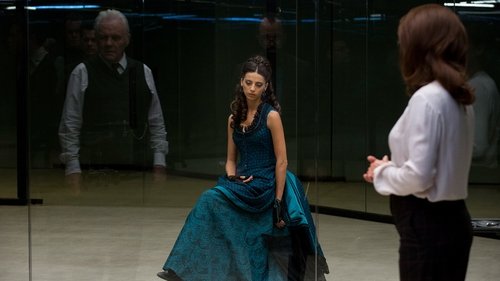
Last but not least, we get a Durden-esque reveal, that Bernard is, in fact, a robot. And if that weren’t enough, we also find out that Ford is willing to have his robot kill, or at least injure, to protect himself and his life’s work, with Hopkins turning up the villainous menace persona that calls to mind his most famous character. When it rains, it pours, and after episodes and episodes of hints and gestures, *Westworld* puts its cards (or at least enough of them) on the table.
The reveal about Bernard is a genuinely shocking one. I literally gasped when he looked at the plans for his own design and said “doesn't look like anything to me,” a nice touch to add weight and poetry to the reveal. But I’ll admit I’m a little concerned about where the show goes from here. Lord knows *Battlestar Galactica*, another show deeply concerned with whether there was an soul in machines, started using the “who’s really a cylon?” game as a crutch after a while, and I’m loathe to see *Westworld* fall into the same trap.
And yet, the idea of someone who knows of Westworld, who’s smart and sophisticated enough to program “hosts” and, as Bernard’s relationship with Theresa shows, passes the most personal of Turing Tests, but who is, unbeknownst to them, also a robot, is an intriguing and compelling one. His false memories, the shock of knowing that your life is a fabrication, is rich material. It remains to be seen whether the truth of where Bernard came from will be worth more than that momentary shock, or whether *Westworld* will harvest something worthwhile from that fertile ground.
Either way, it’s nice to see the show finally letting the audience in on all of these secrets. Given the *Game of Thrones*-esque model that *Westworld* is following, I have no doubt that there will be many more secrets and reveals to come. After all, we still don’t know much about The Maze, or about Arnold, or about what Ford’s master plan is. But even if it took seven episodes, finally knowing what the vast majority of the characters want, about who they really are, gives *Westworld* a purpose and a momentum that it’s otherwise struggled to maintain up to this point.

 Plex
Plex  Kodi
Kodi  Stremio
  Jellyfin
  Netflix
  Disney+
  Prime Video
  HBO Max
  Trakt
Trakt  TMDB
TMDB  Letterboxd
  IMDb
IMDb  Simkl
Simkl  TVTime