An interesting, weird episode of The Sopranos. The most striking thing about it at first blush how great James Gandolfini is at portraying what Tony Soprano might have been like if, as he mentioned in "College", he'd decided to sell lawn furniture on Route 9 instead of going into the mob. Even before he opens his mouth and we start hearing many more Rs than we're used to hearing from him, there's something in how Tony carries himself while walking up to the convention that immediately conveys the fact that he's a different man than the one we're familiar with. It's incredibly fascinating to see Tony as a shnook, to use a term from 'Goodfellas'. The way he's largely impotent and meeker, the way he's still too focused on his work and apt to cheat on his wife, even if he's less successful in both areas, the way he's polite and smiles and is uncomfortable at having to lie. Whether this is all in his head or purgatory or something else, it's an intriguing glimpse at the malleability of Tony; that while certain things are set as part of his personality, he could have been a very different man with a very different life.
There's a lot of religious imagery in the episode, and a lot of reason believe that Tony is in purgatory, if only in his own mind. He's stuck, unable to get back home or go on to his next stop. There's footage of flames from Costa Mesa suggesting hell, a religious infomercial suggesting heaven, and even a confrontation from Buddhist monks suggesting reincarnation. The entire exercise is much more linear and much less surreal than Tony's usual dreams.
All the while Tony is asking "Who am I?" "Where am I going?" "What's the point?" He picks up the wallet of one Brian Finnerty -- it's a bit of a reach, but the name sounds Irish and may be a hint toward the idea of Hell as an Irish bar as Chris once reported -- a sign that the doppleganger who took Tony's briefcases represents the life of the man we've come to know, and that it has a definite ending. And yet, there's also the strange conclusion to this little scene that Schnook Tony has alzheimer's, that he will literally forget who he is. Tony is spiritually and emotionally lost; he essentially admits as such; and yet there's a sense to all this that even if he had avoided the mob life, he still might have experienced something less than fulfilment and ended up like Junior.
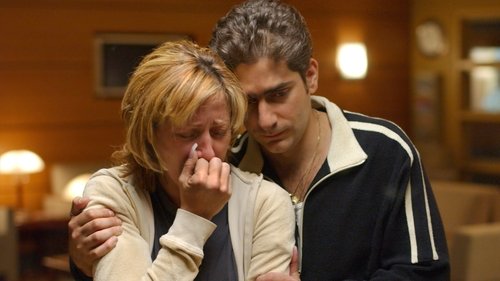
In an odd way, this episode feels like two distinct episodes: one about Tony in his coma, and the other about his family and colleagues holding things together in his absence. I will continue to gush about Edie Falco and how amazing her work on this show is. Her monologue with Tony in the coma and her tears at hearing that Tony will likely die (news delivered by Masuka from Dexter!) absolutely blew me away. Robert Iler was less impressive as AJ (and that's no sin as compared to Edie Falco), but he was still moving and believable as a bratty teenager when he too spoke to Tony in a coma and vowed revenge on Junior. One of the most interesting moments of this side of the episode for me was when AJ said "poor you" to Meadow, in a frightening echo of Livia that suggests her grandson may have absorbed more from his grandmother than it initially seemed.
The mob stuff on the edges was a little less interesting, with Silvio consolidating things in Tony's absence and Chris rising in prominence as well, but mostly this was an episode about Tony's journey and his family coping with it, and while the tone occasionally felt different from the usual Sopranos vibe (likely intentionally), it still worked amazingly well.
That's actually a part of why the show is great. The realism of the fact that, no matter how powerful you are, time can always beat you.
Glorious deaths are rare in real life. The default is to fade away into a sad, forgettable, underwhelming death.

 Plex
Plex  Kodi
Kodi  Stremio
  Jellyfin
  Netflix
  Disney+
  Prime Video
  HBO Max
  Trakt
Trakt  TMDB
TMDB  Letterboxd
  IMDb
IMDb  Simkl
Simkl  TVTime