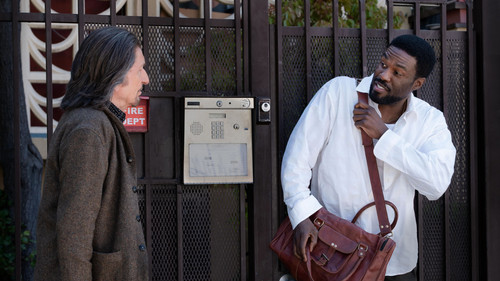
[88/100] “Self-Tape” is sturdy. Trevor has a clear goal -- put the feds’ CPU-hacking ring on Simon’s laptop. Simon has a clear goal: film this all-important, self-taped audition for the big casting director and, by extension, find somewhere to tape the audition. That helps orient “Self-Tape” as a single episode with a specific challenge to be overcome, even as it’s plainly a chapter of a larger story. The twin goals spur Simon and Trevor to make their way across Los Angeles, bumping into people and, naturally, getting to know one another a bit better.
That is, in essence, the real story. Trevor is a double agent. More than that, he’s an actor. This is a mission, but it’s also a job. So when he’s getting into Simon’s good graces, building up a rapport with him, it’s calculated. If he wants to avoid going back to jail and serving out the remainder of his sentence after the events of *Iron Man 3* and *Shang-Chi*, then he’s got to get close enough to this overeager young actor to slip some tech past him.
Over, along the way, they go through things together and, as is inevitable, they bond. They go to a self-tape studio and share mutual frustration at the meddling operator. They go to Trevor’s apartment and Simon looks on with awe and admiration and the artifacts of the life Trevor built for himself on and away from the stage and screen.
Oh, and they also go to Joe Pantoliano’s house, with all that entails.
Pantoliano is such a good sport for doing this role. In some ways, “Self-Tape”’s depiction of the actor is flattering. In *Wonder Man*, Pantoliano is successful, he’s generous, he’s gregarious, he’s offer only. This is certainly a favorable presentation of the man when it comes to material success.
But he’s also the bad guy here. He exists to throw his success in Trevor’s face a little, to have what the show presents as the wrong perspective on this artform the three men share, to be condescending and full of enough backwards compliments that Simon can stand it no more and call him out for it.
It’s a great performance from Pantoliano, who mixes comfortable ease with gentle but painful tweaks brilliantly. But it’s also a kind of selfless performance, one where he’s willing to make himself, not just his character, seem like an asshole behind a smile.
But what I like most is that it reveals a little bit of who Simon and Trevor are in reaction to him. Trevor is slighted, feeling like Joe stole his thunder on an old show. In probable fact, Trevor was likely having personal problems that, at a minimum, made it easier to suggest that he wasn’t up to this, and there’s an interesting character note there. The show’s version of Pantoliano seems like he might be a quiet jerk, but there may also have been issues of Trevor’s own making that he’s projected onto other people, especially those who judged him.
Simon doesn’t judge him, though. He accepts Trevor, not as a means to an end like the feds, or as an old sparring partner to knock down one more time like Pantoliano, but as an ally, someone to look up to, who has the wisdom and friendship to bring out the best in him. That is a rare thing, and as the closing scene suggests, not the kind of camaraderie that Trevor is used to. Simon standing up for his friend, giving up a chance to film his audition in the home of a bigshot because he can't stand to see Trevor maligned, is rousing. (And his extra beat at seeing the poster for *Baby’s Day Out* in the bathroom and then insulting his host for it is hilarious.)
And for Trevor, it shows that whatever his faults, whatever his missteps over the years, however self-aggrandizing he can be in places -- he genuinely cares about his art. I don’t even necessarily agree with Pantoliano’s comments to Simon in the episode. Maybe it’s just the lingering echoes of *Sunset Boulevard* (which *Wonder Man* has shades of), but the entertainment industry can chew people up and spit them out. Treating it as a job like any other, but not the place to find validation or rest your self-worth on, seems sensible. His advice doesn’t seem wrong-hearted to me, and for someone like Simon who can be obsessive, it sounds like something he could stand to hear.
And yet, there is something just as rousing at Trevor offering him the rejoinder that acting is the best thing a person can do. His experience is different, coming from a place of want whereas Pantoliano’s comes from a place of comfort and success. But it also comes from a caring parent who saw the best in her son and in his profession. Whatever foibles Trevor Slattery may have, he believes in this thing, and that's endearing.
He also believes in Simon. I love the cinch of “Self-Tape”. So much of the episode is spent in a sort of comedy of errors mixed with a travelogue. Simon and Trevor ramble around the city, looking for place after place to do each’s All Important Thing™, only to be thwarted at every turn by meddling owners or noisy neighbors or undermining frenemies.
Only then, when they go back to Simon’s apartment, they find what they’ve been looking for in the scene --n not just a place to film, but the kind of bond that brings out the best in both of them. Simon finds his take on the material, one founded on connection with shades of the one he’s forged with Trevor. And Trevor finds new meaning in the words, remarking on the lack of judgment from Simon as both his scene partner for this script but also as a person touched by Simon’s defense of him. Both find something real that elevates this all important audition into something meaningful between them, that shows up on the screen in-universe and out.
It’s enough for Trevor to hesitate when it comes time to hack his new friend’s computer. There’s just enough hesitation to show that Trevor is starting to sympathize with his target. He realizes that this job, just another job, may be something bigger and more real than that.
And then he sees the damage in the wall.
Look, I’ll be up front. I know basically nothing about Wonder Man as a character. Is he like The Hulk where he transforms and wreaks havoc? Is he like Scarlet Witch where his great power means emotional disturbances can have destructive consequences? I don’t really know.
But it means that at the same time Trevor is seeing the good in the man he was sent to ensnare, he’s also realizing that Simon could be legitimately dangerous. The goal was clear at first. But now, with someone in his corner for the first time since his mother cheered him on, and someone whose dangerous potential is suddenly evident,, the goal, and the job, just got fantastically more complicated.

 Plex
Plex  Kodi
Kodi  Stremio
  Jellyfin
  Netflix
  Disney+
  Prime Video
  HBO Max
  Trakt
Trakt  TMDB
TMDB  Letterboxd
  IMDb
IMDb  Simkl
Simkl  TVTime