[9.0/10] I always kind of hated it when Obi-Wan mused to Luke that what he’d originally told him about Vader was true “from a certain point of view.” Just admit you were lying to the kid to protect him, Kenobi! Just admit that you retconned that part after you wrote *A New Hope*, George! Maybe, in hindsight, it should have been my first clue that the Jedi were not necessarily above board at all times.
But I’ve always kind of loved his follow-up statement, “You're going to find that many of the truths we cling to depend greatly on our own point of view.” It’s a reminder that the world is filtered by the lens through which we see it. So our culture, our upbringing, our biases, color what we see in others, and of ourselves. And you wanted to put the theme that runs through “Choice”, and arguably all of *The Acolyte* in a nutshell, I think it comes down to that face-saving statement from none other than Obi-Wan Kenobi.
It comes through in “Choice”, which presents the other half of the story told in “Destiny” about the confrontation between the Jedi and the Brendok Coven that sparked all of these events. There were a lot of conspicuous gaps in what we saw there. The penultimate episode of the season answers important factual questions about what set off the conflict between the Jedi and the Coven, about how the witches were all incapacitated or killed, and about what really happened with Mae starting that fire.
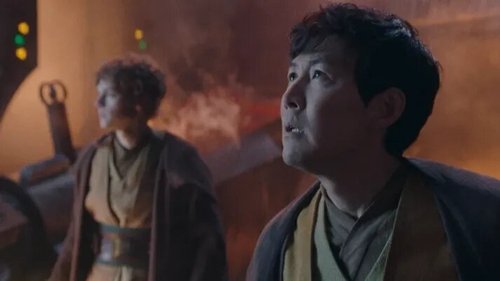
But more than those plot points seen with added clarity, “Choice” recontextualizes what we saw earlier by casting the events we witnessed through the eyes of the Jedi rather than through those of the witches. Suddenly, the interlopers who would dare to try to steal young children away from their family are caring crusaders who worry that the children might be being abused in some form or fashion. Seeming attempts to test the children so they can be taken away are, in reality, just stalling tactics so the Jedi can receive official orders from the Council. And most importantly, neither group is the unified front they seem to those on the other side.
I think that's my favorite part of all of this. Every group, every person here, contains multitudes. The Coven and the Jedi are not a case of good versus evil, or viciousness versus nobility. Both sides have those who are belligerent and more accommodating, those who fear and judge the other side and those who take a more measured approach . Both make understandable, if at times overzealous moves to defend themselves or neutralize a perceived threat. Both sides bicker and worse within their own groups when it comes time to decide what to do.
Master Indara wants to play things by the book and avoid interfering with the Coven, practicing measured Jedi detachment. Sol is more emotional and concerned for Mae and Osha’s safety, with the lurking possibility that he might be blinkered by an emotional attachment to them. Torbin is a young and brash padawan who just wants to complete this boring mission and go back to his home. They all have different ideas about why they’re there, what the Coven means, and what their next move should be.
It’s a mirror of what we saw within the witches’ walls in “Destiny”. Mother Aniseya and Mother Koril continue to argue and take different approaches. The Coven itself stands opposed to its leader when it comes to the question of whether to let Osha go. Even the girls, who are twins and maybe more, stand in marked difference in their wants and personalities.
Neither the Jedi nor the Coven are a monolith. There are complexities and disagreements inside that get flattened when viewed from the outside. Hell, there’s multitudes within each leader, with Aniseya as both leader and mother, and Sol as both centered Jedi Master and emotionally affected human being. And the reveal that this situation, these people,are that much more complicated than they, or we, though, shows some excellent storytelling.
The events of Brendok are a tragedy, not just for one side or another, but for everyone. They are the result of a series of choices, yes, but also a confluence of accidents, of skewed reactions, of human frailties, that coalesce together into death and regret.
Torbin is young and restless and thinks that finding the vergence within the witches’ stronghold is his ticket out of this dump. Mae is young and angry and made more so by a mother who’s implied to have suffered mightily at the hands of the Jedi in the past. So he starts a confrontation that ratchets up the tension on top of everyone’s preexisting mistrust. And so she starts a fire meant to be small and symbolic that gets out of hand and ultimately wrecks everyone. That's a metaphor for these events in micro and in macro.
Because that's what leads to a little girl pleading to her mother that something is terribly wrong. That's what leads to a mother using her abilities to try to help a child in danger. That's what leads to a concerned peacekeeper to fear he needs to stop an attack on an abused child. That's what leads to the tensions erupting into full blown conflict, where mistaken attack begets furious defense, begets escalating assaults on both sides that, in the end, leave the children both sides were trying to protect without their parents and guardians.
There are no heroes or villains here, just complicated people, each with their own understandable interests, tripped up on mistrust and misunderstandings and their own personal hang ups, in a way that swirls together into terror and tragedy. Both sides make mistakes. Both sides come with noble intentions. Both sides lose a great deal in the process.
Oh yeah, and there’s some more frickin’ badass lightsaber fights.
Without closer study, I can't tell you why the battles we’ve seen on *The Acolyte* are so much more riveting and blood-pumping than a lot of those elsewhere in Star Wars. It seems like the directors are taking an approach closer to elevated wire fu rather than frantic sword fights, which tends to be my speed. But suffice it to say, it’s all a thrill.
As new Force-related powers go, watching Aniseya and Koril devolve into smoky wisps is creepy and cool in the best way. Watching the hum and sway of the Coven possessing one of their enemies and turning him against his allies gives you the sense of their power and the uniqueness of their attacks relative to more physical enemies. And my god, watching Torbin, Sol, and Indara have to fend off the brutish-yet-balletic attacks of a witch-addled Wookiee, while trying not to wound their friend, is absolutely incredible. The big set piece here, that pays off so much building tension, is cathartic in the action that erupts after so much of a sense of the dam about to break.
And yet, the most powerful moment comes in what sparks it all, in Sol killing Aniseya mid-transformation and realizing that he was slaying an unknown ally to his cause rather than a foe causing harm to those girls. The grief on his face, Koril’s widowed fury, Sol’s resigned unwillingness to do more than offer a desultory defense in the shadow of his grave error, all sell the moment when the Jedi realize the horror that they’ve wrought, and the hell that breaks loose in the aftermath.
Honestly, that's just scratching the surface of this one! It’s easy to see Aniseya and Sol as kindred spirits, a desire to protect the same innocent children from the other unwittingly uniting them before it cleaves everything apart. But holy hell, Aniseya’s “Would you like to live deliciously?”-style temptation of Torbin in the name of gaining a bargaining chip against the Jedi plays like a truly devilish manipulation on her part.
Likewise, Indara goes from being the invading interloper to being the voice of caution and restraint. The way she presents a unified front to the Coven, but in her own camp, is asking age-appropriate questions of Mae to check for abuse, chastens Sol over his emotions interfering with his judgment, and basically tries to hold back her crew from intervening all paint a very different picture of her. Again, showing us more depth and complexity within the situation is never a bad thing.
So even when she nearly loses her cool with Sol, when she, who’s preached such restraint, doesn’t want to rob Osha of more than she’s already lost, when she’s the one who offers a lie of omission, it carries weight, and adds even more complexity to the situation. It completes the picture for the audience, but not in a way that makes the answers feel rote or mechanical. Instead, we see a broader tapestry of choices, each made for comprehensible and personal reasons, that nonetheless add up to disaster. Without getting too grandiose, that is some *The Wire* kind of stuff.
You can argue about each individual choice made by each person involved in this situation. Plenty made mistakes. Plenty of those errors came from flattening the other side into something that fit your preconceived notions about them. Plenty came from assuming the worst based on incomplete information. The lesson seems to be less about who’s good and who’s bad, and more about the tragedies that unfold in the wake of two groups only seeing glimpses of one another, and folding those into their understandable but ungenerous assumptions about each other, until things have gone too far.
But everyone in that struggle had their reasons. Everyone involved had their understandable intentions, born of their past experiences and personal issues. Everyone thought they were doing the right thing, and maybe they were, from a certain point of view.

 Plex
Plex  Kodi
Kodi  Stremio
  Jellyfin
  Netflix
  Disney+
  Prime Video
  HBO Max
  Trakt
Trakt  TMDB
TMDB  Letterboxd
  IMDb
IMDb  Simkl
Simkl  TVTime