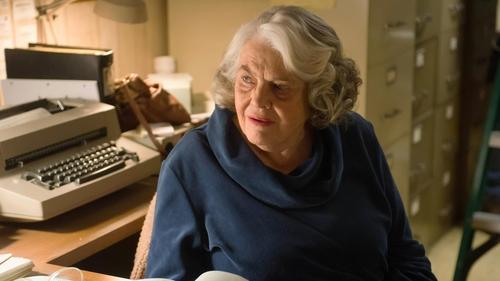
[9.1/10] Where in god’s name did Lois Smith come from and why isn’t she in everything? I’m not sure I can recall a better one-episode character. Smith walks in, takes a difficult role that has to stand in for both the manifestation of the marital issues that Philip and Elizabeth are dealing with, and as the moral center of the show in just a handful of scenes and monologues, and she absolutely knocks it out of the park.
It’s probably too much to call “Do Mail Robots Dream of Electric Sheep” a bottle episode. It’s not the most wide-ranging outing *The Americans* has ever had, but you have the subplot with Stan and Oleg, and wrap-arounds with Martha and Hans that mean it’s not just a one-room story. And yet, wide swaths of the episode take place in the machine repair shop, where it’s basically just Elizabeth and Betty, talking about their lives, and halfway summarizing the core of the season and maybe the series.
That core comes from an essential drift between Elizabeth and Philip, manifested by a closeness that’s emerging in their fake, or at least less real relationships. There is a trust between “Clark” and Martha, to where after everything, the lies and the realization of the position he put her in, she’s still informing on her FBI coworkers. When it comes time for Gabriel to decide what to do with the knowledge that the Bureau knows about the bugged pen, he agrees with Philip that Martha can be trusted, because she’d do anything for him.
The same is true for Elizabeth and Hans. When Elizabeth tells her young trainee that he can’t stay in the game since their mark from the last episode saw him, he responds. He kills the young man that the Jennings spared (so much for second chances), to tie up that loose end. He speaks in soaring rhetoric about doing it for his country, but he also says it’s so that he can keep working with Elizabeth. He is so into this, so into her, that he’s willing to kill for it.
There’s a level of devotion and trust in Martha and Hans that’s missing between Philip and Elizabeth at this point in their relationship. The season has belabored the point at times, but the issue with Paige has divided them, and each is wondering if they’ll ever be able to get back to some semblance of normalcy and mutual understanding again.
That’s where Betty comes in. It’s a television convention and cliché to have a character we’ve never seen before conveniently start recounting their life story in a way that directly rates to the themes of the episode. But that’s what makes it so damn impressive how well this works here. Betty’s stories of her life, of her husband being affected by what he’s seen, of her shock that Elizabeth is a mother who does evil things, are compelling in the moment in a way that excuses the slick television writerliness of it all.
I think my favorite part was the revelation that Betty and her beloved Gil had been divorced and remarried, with another wife in between. It’s a little on the nose, but her talking about the pair no longer having “sugar in their eyes” and no more fights about “not being what I want rather than what you are” feels like the wistful wisdom that the Jennings need. The sense of her husband having lost his religion given what he’d seen at war, how that haunted him, gives it an extra resonance for a pair of communists who do harsh things on a weekly basis. Just writing it, it sounds cheesy as hell, but in action, you 100% buy it as the remembrances of a woman who realizes that this is the end of her life.
That’s the other part that makes this one so piercing -- Betty’s death her feels so tragic and, though no one lays a hand on her, brutal. When Philip says, “She picked a bad night,” there’s a senselessness to it. This woman isn’t the enemy of the Russian government. She’s just in the way. That makes it feel unfair that she has to die, just so a mail robot can be tampered with without anyone knowing.
But it gives Elizabeth a chance to be honest about who she is with someone who can’t tell her tales, to offer a form of confession to someone who psychologically stands in for her own sick mother. And it gives Betty an excuse to tell her life story to her killer, because she has no one else to tell it to. There is a symbiosis here that reverberates between the two of them even though Elizabeth is very taciturn here, alternating between that dead-eyed menace that Keri Russell is frighteningly good at and the wounded doe look she takes on as things get harder.
Things get harder when Betty asks if Elizabeth has children, and when she confesses that she does, and explains, to Betty’s horror, that she does this to make the world a better place, Betty replies, hauntingly, that that’s what evil people do to excuse their deeds. It’s another brick in the wall of Elizabeth and Philip wrestling with their morality of their mission and profession, and of whether or not to bring Paige into this world.
That’s given extra force with Betty’s stomach-wrenching death. It’s easy to get into skirmishes with equal and opposite spooks or FBI agents who have guns and plans to ruin your life. But this is just a kindly, moral, old woman. The gasping, disoriented, disturbingly normal way in which she perishes from an overdose of her heart medication pierces us, and pierces Elizabeth as well in its frankness.
It’s the kind of thing I like, and the thing that television does like no other medium. Here is a whole story, a whole life, in miniature, that doesn't move the plot or shift any of the story’s heavy machinery (the mailroom robot excepted). It’s just there to move *us*, to make the characters think, to leave wisps of doubt and regret in their minds that may float behind their eyes at the next killing or the next time they hug their kids goodnight or the next time they fall asleep together. It’s all because of one extended sit down with an old woman, who reflects Elizabeth’s life back at her in a way far more frank and honest than this veteran spy is used to in her world of layers of lies and codes and meanings that are frustratingly, but sometimes comfortingly, below the surface.

 Plex
Plex  Kodi
Kodi  Stremio
  Jellyfin
  Netflix
  Disney+
  Prime Video
  HBO Max
  Trakt
Trakt  TMDB
TMDB  Letterboxd
  IMDb
IMDb  Simkl
Simkl  TVTime