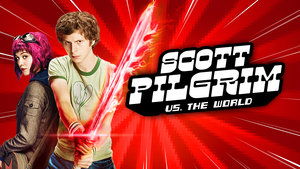
[7.7/10] My wife and I watched *Scott Pilgrim vs. The World* on our first date. In hindsight, it seems like a bad movie for a first date. The protagonist is shitty with pretty much everyone he’s dated. There’s cheating. There’s ghosting. There’s scads and scads of dirty laundry from tons of bad relationships tossed around with candy-colored glee. It’s not the most inspiring or heart-warming movie in terms of romance.
But maybe it was the right movie, because despite how crappy a lot of the relationships featured are, and how bad Scott in particular is through most of the film, it’s a story about seeing past yourself and your own hang-ups. It’s about acknowledging that everyone has baggage from their romantic pasts, that framing yourself as the victim can easily become an excuse to ignore pain you yourself caused to others, and that it’s more important to work on who you are than to obsess over someone else who you imagine will solve all your problems. It takes a while to get there, but those are better morals than you’re likely to find in most traditional romantic films.
It’s also anything but a traditional film. Separate and apart from the morals at play, director Edgar Wright and his team create an audio-visual experience unlike anything else. More than just the inventive special effects and heightened reality flourishes, Wright and company toy with the very grammar of cinema. Despite a devotion to the moving image, *Scott Pilgrim* takes more cues from music, comic books, and video games than it does from conventional pacing, editing, or composition.
That pops up in visually obvious ways like the comic book like “krak”s and “thonk”s of onomatopoeia that emerge during fights and moments of self-flagellation. The video game influences are plain when victory equals coinage or snippets of chiptunes play in the background of key moments. And the movie conveys music like no other, with impressionistic representations of sound and emotion that fit the exaggerated tones of the movie.
But Wright’s adventurism goes beyond those easiest-to-latch-onto elements. His scene transitions don’t feature the usual straightforward cuts, but rather titles or sequences that make for more unique transitions or that simple blend into one another. Flashy techniques like split-diopter shots give us multiple close-ups in quick succession or help him juxtapose images like panels on a comics page. Even the pacing of the movie scans differently, with few of the traditional pauses or rests, instead just ratcheting up from event to event in a fury.
That helps give the movie such a distinctive feel. Given the magical powers and coin-ridden “fights to the death” at play, it doesn’t take much to realize that Scott Pilgrim occupies a very heightened reality rather than the real world. But that exaggeration isn’t just set dressing. The entire premise is a high concept realization of what it feels like to deal with other people’s romantic histories and, eventually, confront your own. Wright busts out scores of unusual tools in the cinematic toolbox or uses familiar ones in unfamiliar ways to convey those big emotions in a way that is both palpable and different from anything else in cinema (give or take *Speed Racer*). The over-the-top elements work as funhouse mirror versions of real experiences, which helps *Scott Pilgrim vs. The World* stand out and work in concert between its story and presentation.
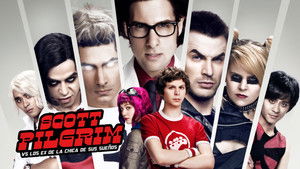
That doesn’t stop Wright and his collaborators from just having fun though. The fight scenes work apart from the broader plot, with colorful and creative throwdowns with a ludicrous flair. For a movie that promises seven battles (more like six, to be fair), it never feels repetitive, throwing new wrinkles into each challenge that make them their own thing, both in terms of the setup and the emotional point the movie is making in these scenes.
It’s also a funny movie in a low-key, off-kilter sort of way. There’s few traditional jokes here, but a lot of awkward or silly situations, visual gags based on the video game conceits, and chuckle-worthy dialogue. The script nicely walks the line between the droll way that young folks communicate with one another, while also adding nice bits of stylization that give the conversations a rhythm and lyricism appropriate for the movie’s musical bent.
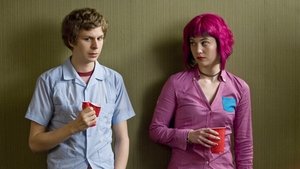
Those conversations typically happen around Scott and his fraught romantic life. Over the course of the movie, we see Scott still smarting from his break-up with his last girlfriend a year later. He takes comfort in Ramona because she’s already cool and seems to like him, in contrast to Nat who seemingly became too cool and lost interest in him. Ramona likewise finds comfort in Scott because she’s running away from her own bad relationship, with Scott representing someone who will chase her rather than mess with her head while she chases him.
The cinch of the movie is Knives, the teenager admirer whom Scott cheats on with Ramona and treats as excess baggage himself once he begins to fixate on his new color-capped paramour. The turn of the film is Scott learning to empathize with Knives and with Ramona, to filter the pain he causes each of them and what they’re going through via their own perspectives and experience rather than just his own. While the film is nominally a romance or an action movie, at base it’s one of personal maturity and empathy, where how you treat others is more important than who you end up with (even if who Scott ends up with feels a little off).
Ten years later, I barely remembered that, or much of anything from *Scott Pilgrim vs. The World*. I spent most of that first watch fretting over the enchanting woman sitting next to me, wondering if I was destined to become one of her exes, wondering if my own baggage was going to sink me, wondering how our relationship would fit into the different guises and roles that Edgar Wright and company presented for young love and infatuation. The fictionalized version of those stories quickly gave way to the potential real versions I was playing out in my head.
But if I’d paid more attention then, maybe I would have learned something. Maybe I’d have grappled with my own insecurities sooner and better or understood more about the baggage that everyone brings to a new relationship. As all young idiots do, I stumbled plenty as the two of us got to know each other better, and I tried desperately not to screw this incredible thing up.
Somehow, despite not fully comprehending the themes of the movie at the time, I managed not to. But that’s the beauty of returning to movies down the line -- even if they haven’t changed, you have. Watching *Scott Pilgrim vs. The World* in 2010, it would be too much to say I identified with the title character, but I saw him. I got him. I knew how it felt to be the young twenty-something uncertain in love.
A decade later, in a healthy and loving relationship, it’s harder to feel his romantic turmoil, to relate to his fears and hang-ups. But it’s easier to see the lesson about letting go of those things, becoming a better person regardless of who you’re with, and hoping that there’s something better coming on the other side of that door.

 Plex
Plex  Kodi
Kodi  Stremio
  Jellyfin
  Netflix
  Disney+
  Prime Video
  HBO Max
  Trakt
Trakt  TMDB
TMDB  Letterboxd
  IMDb
IMDb  Simkl
Simkl  TVTime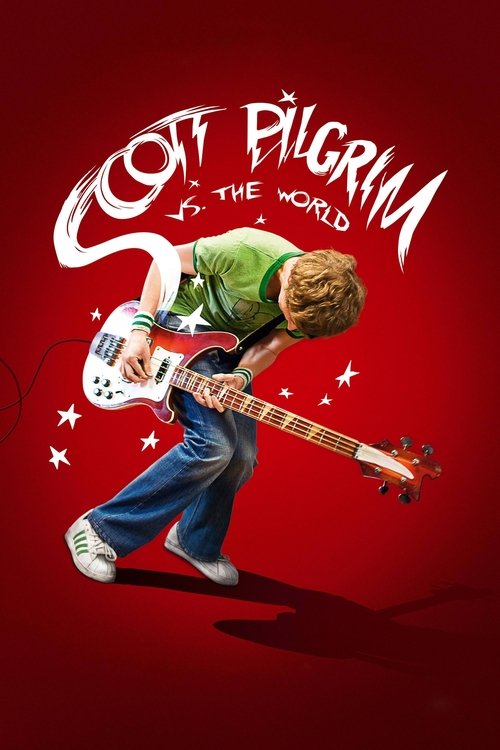
 Japan
Japan United Kingdom
 United States