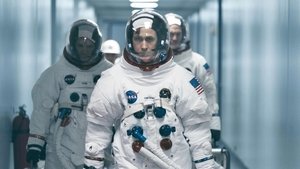
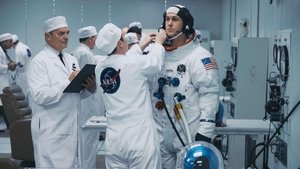
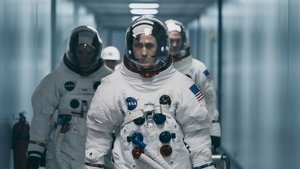
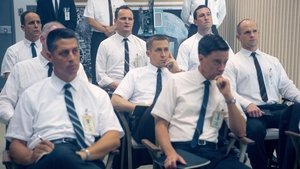
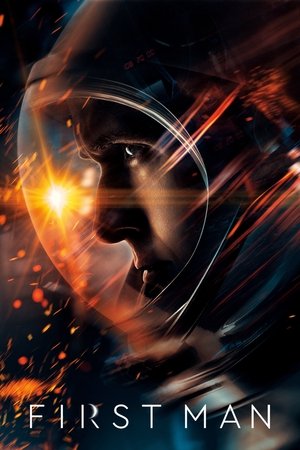
A look at the life of the astronaut, Neil Armstrong, and the legendary space mission that led him to become the first man to walk on the Moon on July 20, 1969.
A look at the life of the astronaut, Neil Armstrong, and the legendary space mission that led him to become the first man to walk on the Moon on July 20, 1969.
Unlike others, <i>First Man</i> doesn't remind me of <i>Interstellar</i> or <i>Gravity</i> but instead the dynamics of the movie calls <i>Malick</i>'s <i>Tree of life </i>to my mind. Just like <i>Tree of life</i>, <i>Chazelle</i>'s depiction of moon landing is not about the act itself but it's a vessel to portray a father's journey through grief and loss. It's not about Nasa and its numerous victories, It's about the people who have been lost to achieve these victories. It's a memorable work of art even though there are bumps along the way and the one that vividly comes to my mind is the cinematography that is brilliant and tiresome at the same time. Somehow the close shots that <i>Chazelle</i> has grown to love so much don't fit this narrative. Ultimately the movie is a healing flight through overcoming dolour.
<b>× Best Line: </b>I<b> </b>don't know what space exploration will uncover, but I don't think it'll be exploration just for the sake of exploration. I think it'll be more the fact that it allows us to see things that maybe we should have seen a long time ago.
_First Man_ is a decent foray into the history of space exploration, I guess. There were some bits and bobs that bothered me, though.
During the Gemini VIII malfunction, the increase and subsequent decrease in roll speed were matched by what sounded like a jet turbofan engine spinning up and down. That struck me as very odd—the only active propulsion system was a stuck maneuvering thruster (OAMS number 8), a rocket engine burning hypergolic propellants. In other words, it couldn't make the same noise as a turbofan, even if heard from inside the cockpit. It's doubly odd because the film goes to such great pains in the latter half to keep space scenes silent. Some exterior shots of the spinning Gemini VIII included the anomalous jet-engine sound.
Since watching the film this afternoon, I've done some more fact-checking—or rather, read up on other people's fact-checking. A number of events depicted in the movie were "wrong" somehow. Timings changed (the X-15 flight depicted happened in 1962, but the film states it was 1961); there were no apparent rescue attempts during the fire onboard Gemini I (in reality, ground crew tried to open the hatch, hampered by smoke and flames escaping the sealed capsule); the astronauts had clear views out the capsule windows during the Apollo launch (in the real Saturn V, the launch escape system covered most of the Command Module windows until later in the flight); and Neil Armstrong trained in the three-axis spin device (the Multi-Axis Spin-Test Inertia Facility, or MASTIF; in reality, it was ironic that Armstrong never trained in the device but was the only spacecraft pilot to experience the conditions it simulated on a mission). Numerous other, smaller details are incorrect, as well.
The big one I want to talk about, though, is how much bloody camera shake there is during any flight scene. By astronauts' accounts, riding the Saturn V to space was a very smooth, almost relaxing, experience. But in _First Man_ every space vehicle seems to be trying to shake its occupants (and itself) apart during flight. I can't think of any reason for this, other than "it makes things look more dramatic". Unfortunately, the sheer intensity of the camera shaking makes useless the carefully framed extreme close-up shots of controls being actuated, as the button and switch labels are unreadable due to motion blur. It also makes it extremely difficult to tell who's who on screen, when faces are shown. So, aside from being unrealistic, the violent camera shaking actually hurts the narrative.
But enough nitpicking the technical stuff. I've spent 444 words on this nitpicking section, and I haven't even touched on the script yet!
----
Again, _First Man_ is a decent foray into the history of America's space program. It definitely focuses on the man, not the machine. Or at least, it _tries_ to focus on the man.
The biggest complaint I can level at the script is its pacing. Most of the film drags pretty badly. I have to admire Damien Chazelle for making such a _pretty_ film—so many of the shots were breathtaking, both in space and back on Earth. The same cannot be said about Josh Singer's screenplay. Maybe the flaws in the script can be traced back to the book it was based on, which I have not read (nor even heard of before seeing this film).
At any rate, I find that _First Man_ often glosses over the big picture to focus on seemingly insignificant moments. The characters (real people, but fictionalized) seem to remain the same over an eight-year period. That in itself is unrealistic—all people change over time, whether they realize it or not—but it is even more so in the face of such historic achievements.
I contend that the movie spends insufficient time on what happened _after_ Apollo 11. Saying more would require the use of spoiler tags, and I don't want to go down that route—but the story felt somehow incomplete.
My score of 7 is rounded up from the rating I would give _First Man_ if Trakt supported doing so: **6.5/10**

 Plex
Plex  Kodi
Kodi  Stremio
  Jellyfin
  Netflix
  Disney+
  Prime Video
  HBO Max
  Trakt
Trakt  TMDB
TMDB  Letterboxd
  IMDb
IMDb  Simkl
Simkl  TVTime
 United States